
This article is published as part of MPI’s Mining Monitor and its collaboration with Murdoch University on Critical Minerals and Just Transition — a framework that asks not only how we move away from fossil fuels, but who bears the cost and who reaps the benefit of that transition. The current government’s response to Australia’s fuel crisis is a case study in what a just transition is not.
In commenting on energy supply and taxation in Australia, we are mindful of the incalculable human suffering caused by the unnecessary U.S-Israel war and the resulting fuel crisis, which then affects the daily needs of the vulnerable in many of the world’s poorest nations.
Australia is in a fuel crisis. Petrol is above $2.50 a litre. Households are cutting back. The war in Iran has sent crude oil prices past $116 a barrel, cutting roughly a fifth of supply from global markets, and ordinary Australians will have to wear the cost.
The government’s response has been revealing — not just in what it did, but in what it refused to do.
What it did: slash the fuel excise by more than half, handing every motorist a flat discount worth about $79 over three months. A subsidy worth more the more fuel you consume. A blunt instrument that, by the government’s own record from the identical 2022 measure, barely registers at the pump.
What it refused to do: tax the windfall profits of the gas companies making a fortune from the same crisis hitting everyone else. Companies like Chevron and Woodside are profiting handsomely from the price surge. A proposed 25% export levy on LNG — Australia’s own gas, extracted from Australian soil — would have generated an estimated $17 billion annually for the public purse. The government killed it.
And then Anthony Albanese stood before the Chamber of Minerals and Energy of Western Australia — the gas industry’s lobby — and told them: “We recognise that your prosperity is Australia’s prosperity.”
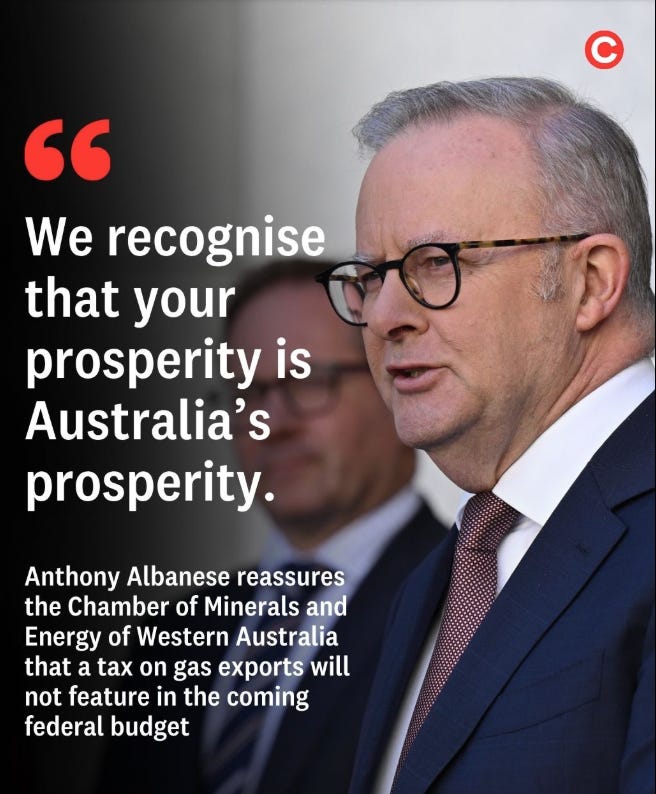
It is worth sitting with that sentence. The higher the price at the bowser, the higher Woodside and Chevron’s margins are. The more the government protects and effectively subsidises gas company profits from taxation, the less it has to spend on people who need it. These are not aligned interests. They are opposing ones. The Prime Minister has simply chosen a side — and said so out loud, to an audience of mining executives, in the middle of a national energy crisis.
Making a Scarce Resource Cheap Accelerates its Depletion.
But there is a deeper problem with the fuel excise cut that goes beyond the politics — one that sits at the heart of just transition thinking.
When a resource becomes scarce, its rising price is not just an inconvenience. It is a signal — to consumers to use less, to investors to find alternatives, to the whole economy to begin adapting. Suppressing that signal through a subsidy doesn’t make the scarcity go away. It makes us respond to it more slowly, while depleting the resource faster.
The scarcity of oil is clearly understood by the Albanese government as a bump in the road — we will soon be returning to normal. But this is simply not the case. We are not just running low on a commodity — we are also running out of time to reduce our dependence on it. Every policy that makes fuel artificially cheap works directly against the energy transition. It suppresses investment in alternatives, delays behavioural change, and trains households and industries to plan around cheap energy — until the next shock hits, and we’re back here again, more dependent and less prepared.
The fuel excise cut is not relief. It is the wrong intervention at the wrong moment, dressed up as compassion. It treats a supply shock — a signal that we need to change — as a problem to be muffled.
The correct response to genuine hardship caused by rising fuel prices is targeted redistribution: direct payments, fuel vouchers, or income support for those who cannot absorb the cost. This preserves the price signal for the overall system and for those who can afford it, while protecting those who cannot. It is better policy in every dimension — more equitable, more fiscally efficient, and more honest about the resource reality we are living in. This is, in fact, what just transition means in practice: not a race to the bottom of the price signal, but a managed, equitable shift that directs resources toward those most in need rather than subsidising and feeding consumption across the board.
The Conflict of Interest Is Now on the Record
None of this is accidental. The government’s own justification for rejecting the export levy relied on figures from Australian Energy Producers — the gas industry’s own lobby group — rather than from Treasury or the ATO. Senator David Pocock noted that the PM was repeating gas lobby talking points. Albanese called the push for a windfall tax “populist” — deploying the term as a dismissal, as though governing in the interests of the majority is something to be embarrassed about.
Meanwhile, 160,000 Australians with disabilities are being cut from the NDIS to save money. The money exists — $17 billion a year of it, sitting in the untaxed margins of companies extracting Australian resources from Australian soil. The choice not to collect it is not a fiscal necessity. It is a political commitment.
Australia’s housing market has been running the same logic for decades: negative gearing and capital gains tax discounts have turned shelter into an investment class, systematically transferring wealth from those who need homes to those who already have them. The fuel excise cut follows the same pattern. Scarce resource, rising price, genuine hardship — and instead of directing support to those who need it most, the government muffles the price signal for everyone while protecting the profits of those already benefiting from the crisis.
Just Transition Requires Honesty About Scarcity
The just transition framework insists that the shift away from fossil fuels must be managed in a way that is fair — that does not simply offload the costs of transition onto those least able to bear them. That principle requires, above all else, political honesty about resource scarcity: what we have, how long it will last, who needs it most, and who can be asked to use less — ‘luxury emissions’ should be cut first.
What we are seeing instead is a government that conflates the prosperity of mining and energy companies with the prosperity of the nation, makes a finite resource artificially cheap in the middle of a supply shock, and calls anyone who objects a populist. That is not a just transition. It is the opposite — a political economy that uses the language of crisis management to entrench the interests of those who profit from the crisis, while the cost is socialised onto everyone else.
We are not going to transition our way out of this if we cannot even let the price of fuel rise during a crisis without reaching for the subsidy lever.
Thermodynamically cheap energy is running out. So is the time we have to adapt to that physical fact.