
We often hear that China has a monopoly on critical minerals, specifically Rare Earth Elements (REE) but that the Western states have finally woken up and are addressing the problem. A new paper by Neil Coe, Lian Sinclair (who is on the MPI board) and Eli Hayes, was recently published in ZFW – Advances in Economic Geography, takes a closer look, adding “nuance to often quite general debates about the return of industrial policy and state derisking strategies”.
Specifically, they take a close look at something rather unglamorous: offtake agreements. These agreements are contracts in which buyers commit, often years in advance, to purchase a given volume of a mine’s future output. The authors built a dataset of 71 of these agreements, signed between 2002 and 2025 between nine Australian rare earth projects and 46-odd counterparties around the world. Mapping these contracts provides a different picture of the REE landscape than the one provided by the government or mining companies.
Why offtakes matter
Rare earths and many critical minerals have atypical markets. The volumes are small, there is no proper spot exchange, and buyers can’t simply ring up to place an order the way they would for minerals like copper or steel. Consequently, offtake agreements become crucial in two different ways: they allow downstream firms (magnet makers, EV and wind turbine manufacturers) to lock in a hard-to-get supply, and, they allow miners prove to potential lenders (public and private) that their project is more than a hole in the ground. They can effectively show that they have future sales locked in. If a given volume of future output is locked in in the form of offtake agreements, then the project will usually gain access to loans to finance the project. And in reverse, a fully funded project that has no clients to sell to, will quickly go under.
This means that tracking these contracts is key to understanding the actual lay of the land rather than rely on public relations announcements. Who buys, who sells tells us a lot about the financial risks as well as the geopolitics behind various mining projects. Mapping the contracts for the main Australian REE miners helps provide a picture of the general trajectory of mineral policy in Australia and globally.
Pulling away from China
The paper shows that there has been a general trend away from Chinese sales. Some existing contracts with Chinese buyers have either been not renewed or were outright cancelled. Nevertheless, and this is the strength the paper gains from the granularity of its analysis, the overall picture is more nuanced than may at first seem. The authors highlight that without Lynas, “no project in Australia has yet found enough buyers to cover 80 % of their planned output, the usual requirement to trigger preferential government loans”. Iuka for example, despite having secure a A$1.8 billion from the government in 2022 has not secured a single offtake agreement with international buyers to date.
Four projects:
The strength of the paper’s contribution comes from comparing the similarities and differences between four of the biggest REE Australian projects.
Lynas is the success story. To sum it up: “Lynas was in the right place at the right time, during successive geopolitical crises (2010 and post 2020), and producing the right type of product to benefit from at first Japanese, then US industrial decoupling from China”. Lynas is used as proof that the model works yet the paper draws the opposite conclusion: Lynas worked because it is so mutually dependent on one state, but that also means that Japan’s needs are fulfilled by Lynas which in turn means that the Japanese market can no longer be a potential customer for Lynas competitors.
Iluka complicates the story. Despite having received A$1.8 billion in government loans and disposing of specific know-how, Iluka has not yet secured any offtake agreement with international buyers. Iluka has nonetheless signed offtake agreements with other Australian miners, one of which created controversy over its part Chinese ownership, the government stepping in to prevent any of the product eventually being sold to China. Iluka serves as an example of the government seeking to decouple from China yet failing to secure mid-stream and down-stream customers for its REE.
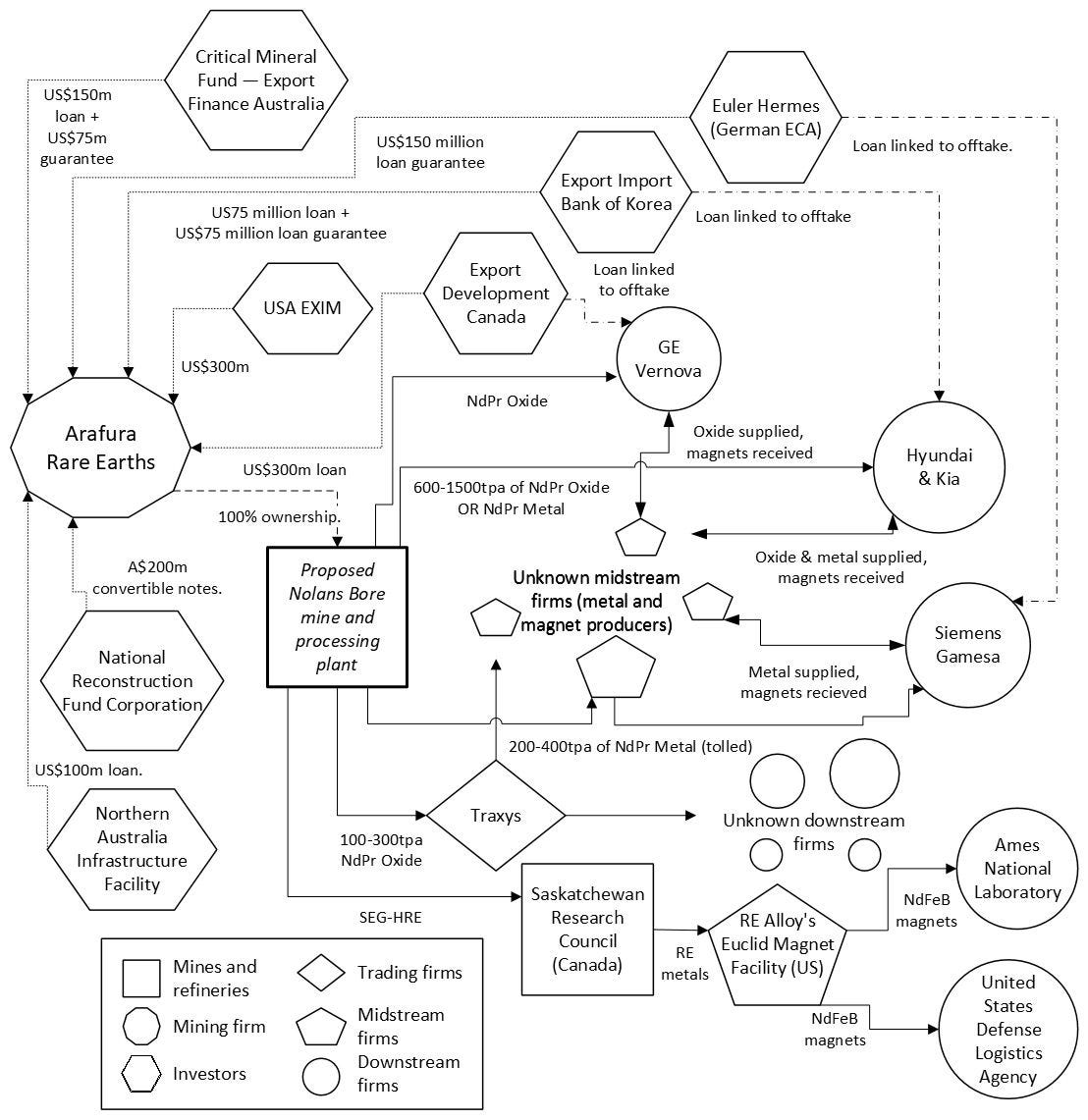
Arafura has customers but small volumes. Arafura deals Western corporations directly (Hyundai/Kia, Siemens Gamesa, GE Vernova) which in turn means much of their financing is explicitly tied to offtake agreements and comes from Korean, German and Canadian export credit agencies which are all significantly smaller REE markets than Japan (already secured by Lynas). Given that the volumes are small compared to what the project needs, the Arafura strategy looks overly dependent on many insecure moving parts.
ASM, despite owning the most technically advanced downstream asset (a metals plant in South Korea), is stuck signing tiny short-term purchase deals with nascent magnet producers who are themselves barely at pilot scale. Its flagship Dubbo project in NSW hasn’t landed a single offtake, so the finance it’s been promised remains, in practice, inaccessible.
‘Derisking’ is doing more political work than economic work
In conclusion, state ‘derisking’ (i.e. the low-interest loans, equity stakes, and guarantees now flowing through Export Finance Australia and equivalents overseas), which comes bundled with de facto “no-China” conditions, is not simply an economic tool; it is the state actively trying to create new, ‘geopolitically approved’ supply chains. What the meticulous analysis of offtake agreements shows, is that the state stepping in in such a way is no guarantee of success if there are not enough buyers for what the state is ‘derisking’.
We are usually told that critical minerals policy is a supply-side problem: we just need to find the ore, build the mine, and the problem is solved. What this paper shows is that a bottleneck also sits downstream. There apparently isn’t yet enough non-Chinese, non-Japanese magnet and metals capacity to buy what Australian mines seek to produce. Until that midstream industry exists in Korea, Europe and North America, Australian miners will be competing for a handful of customers. Geopolitical alignment and state intervention do not in themselves guarantee the viability of REE mining projects.
The conclusion we draw at the Mining Monitor is that even on the economic rationale alone, these so-called critical projects are a lot shakier than we are often told, and this is without having even taken into account the very real eco-social cost of each of these projects, let alone their cumulative impact.
Which is why, we should always keep an eye on mining 😉
Reference: Coe, N.M., Sinclair, L. and Hayes, E. (2026) “Mapping nascent rare earth global production networks in a time of geopolitical contestation.” ZFW – Advances in Economic Geography. https://doi.org/10.1515/zfw-2025-0096