
The following transcript has been edited for clarity from a presentation on Whadjak Noongar Boodja given at the 2026 World Renewable Energy Congress, hosted by Murdoch University.
To achieve a just energy transition, we need to do more than grow our renewable sector and decarbonise our economy. While some sectoral progress has been made in Australia on the back of new policies, technologies and investments, our relationship with energy remains relatively unchanged. The dominant narrative describes a transition in progress, but the socio-economic realities remain undisturbed.
The question I want to put to you is this: Can an electrified version of the status quo really be a transition? And how could it be considered just if we’ve already got existing vulnerabilities that we haven’t addressed? Surely anything that claims to be an energy transition needs to address those as part of that transition — it needs to be more than decarbonisation.
I want to flip this around, because my talk could be seen as pretty negative. What I’m offering is actually a collection of concepts to help create a just transition. If we’re not aware of these issues, how do we embed them in our thinking — our conceptualisation, if you will — of the transition, to make sure they’re addressed as we go along?
Planetary Boundaries
I know it’s a renewable energy conference, but I’m used to thinking a little more broadly about the environment, so that’s where I’ll start — with planetary boundaries.
Is everybody familiar with the concept of planetary boundaries? I’ll give a brief overview. This is definitely not my work — I’ve colour-coded it to make it a bit clearer. There’s a large group of scientists who have been working on this for years, and this is the latest 2025 iteration.
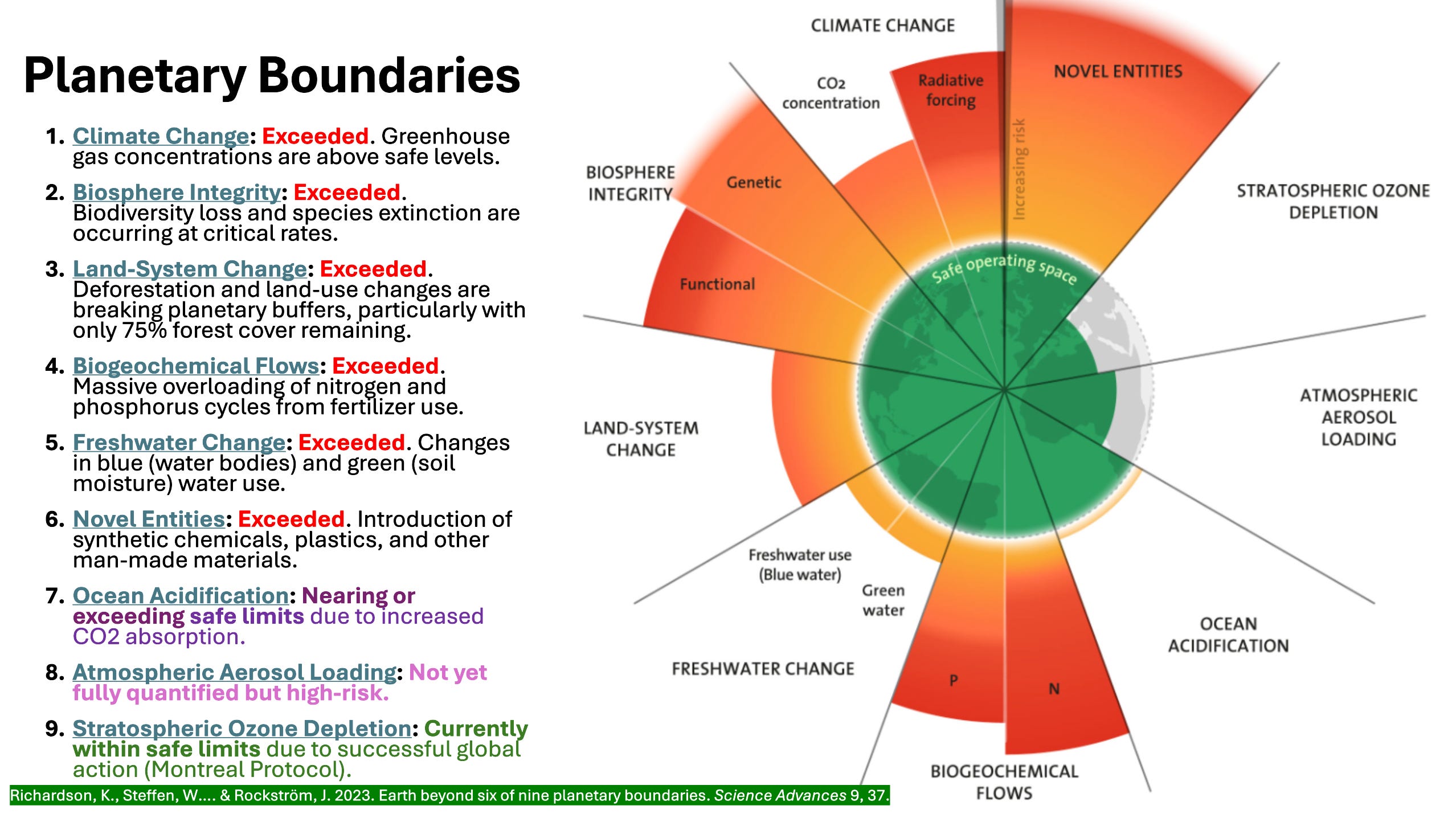
Basically, the red areas in that image are where we are overshooting — we’ve gone well beyond the green safe operating space, creating real harm across multiple sectors. Some areas have improved: for example, atmospheric aerosol loading has been reduced in part because of lower sulphur content in shipping fuel. There is a flip side, though — that improvement has also reduced albedo, meaning we’re absorbing more heat. A rare example of pollution having an unintended positive side effect — one we’ve now removed, which is good for air quality but has a climate downside.
The Doughnut Framework
From planetary boundaries, I want to move to the Doughnut — the social and planetary boundaries framework developed by Kate Raworth. If the planetary boundaries diagram showed us the ecological ceiling, the Doughnut adds the social foundation. We’re looking at ecological overshoot around the outside (the orange and red), and social deficits on the inside. The dark blue areas represent vulnerable communities — communities that may be the sites of extraction, or potentially the sites of our new renewable energy infrastructure.
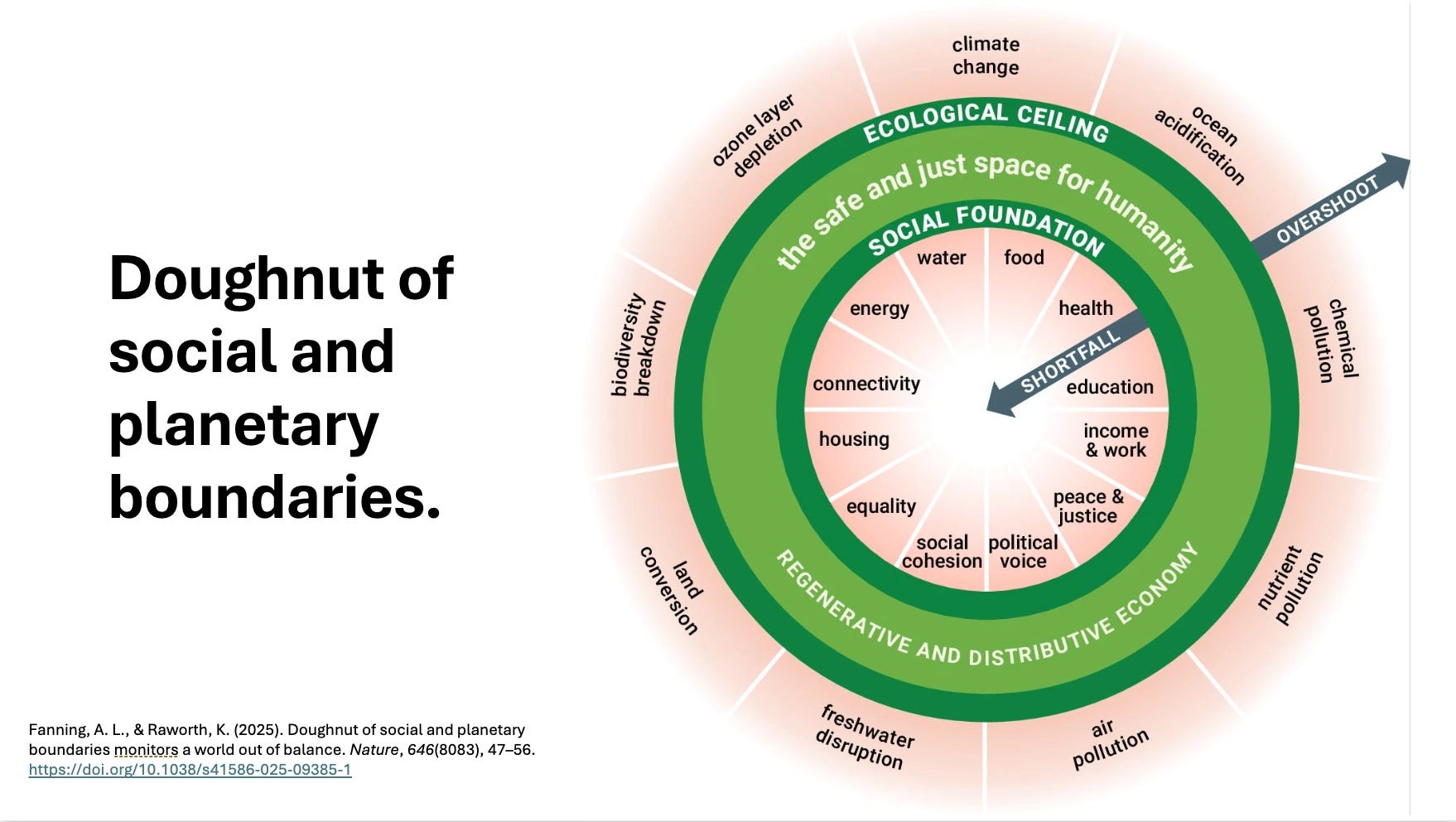
The question the Doughnut asks is: how do we live within our ecological limits while also delivering just social outcomes for everyone?
To make this more concrete, here’s a disaggregated version. The top richest 20% of countries, the middle 40%, and the poorest 40%. Look at the size of the climate problem: the poorest 40% of countries are contributing very little to the need to decarbonise. The middle 40%, a little more. And the top 20% — which includes Australia and all OECD countries — very definitely there.
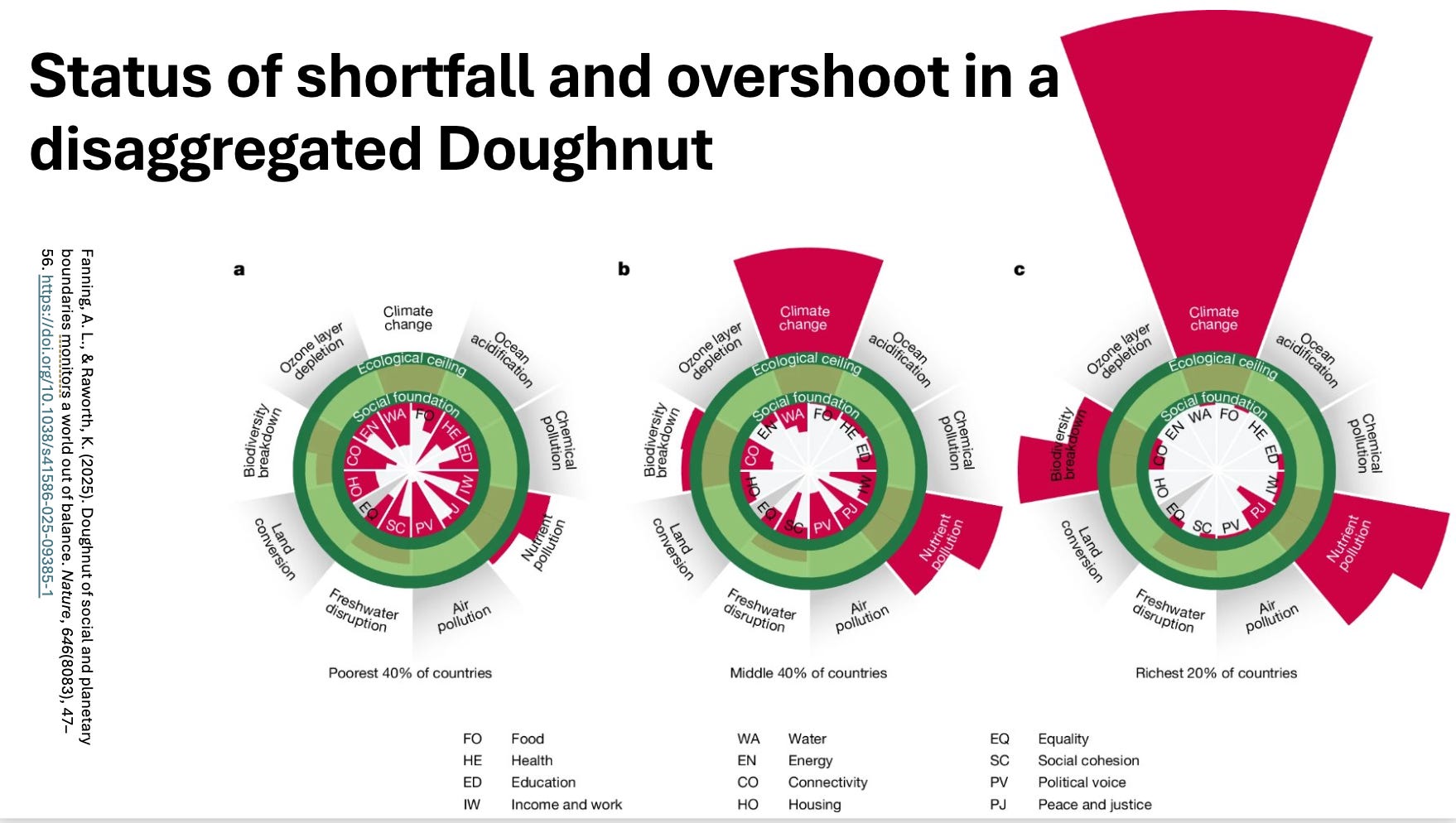
Interestingly, all that economic activity by the wealthiest nations hasn’t even met all of our own social needs. We’ve had enormous economic growth, and we’re still not meeting the social needs of everyone within the richest 20% of countries. In Australia, for instance, we’re still underperforming on gender equality. If we can’t do it here, in one of the most advantaged countries in the world, how do we expect countries in the bottom 40% to do so?
The Abstraction of Energy
This next section is a conceptual leap, and it draws on the work of Lohmann and others. It’s about how we conceptualise energy.
Think about the moment we decided that abstract energy — effectively the electricity that comes through the wires in our walls — would become the basis of our society. That was by no means inevitable. There are many different worldviews that might have chosen a different path, one that didn’t link our social and economic structures so intrinsically to energy. And there have been people within our own societies challenging this for a very long time.
The abstraction of energy is essentially the universalisation of natural resources into a commodified, capitalist form. All those things on the left — burning fuel from the commons, capturing sunlight to cook — they’re all very different energy sources. What makes electricity special is that it enables us to do everything, whereas most natural energy sources are suited to certain tasks.
But the most important thing to consider is what happens in that transformation — from natural energy into abstract energy. I’ve explored this partly through fiction. One of these stories was about the damming of a river. The original First Nations people had a very different perspective on what that river was worth in its natural form. Our socio-economic system had a very different perspective on what that river could produce if you dammed it for hydropower. This is a direct conflict between fundamentally different value systems — different ways of engaging with the world.
The point I’m trying to raise is that we need to be aware that these underlying concepts drive what we see as what we see as solutions, what we see as problems.
As Lohmann puts it, abstract energy is not a universal, non-political resource — it can also be seen as an ongoing colonial process of reorganising human and non-human territories into hierarchies favourable to capital accumulation. Damming a river changes it into something that fits within our very capitalist Western orientation.
To put it in my own words: the abstraction of energy imposes a universalising and homogenising logic on natural energy — compressing all existences, substances, materials, movements, processes and actions into a singular commodified concept of energy, created and harnessed by our socio-economic systems to do work. That’s how we can equate a dammed river, a horse producing energy or even human labour — they only become comparable when we reduce them to abstract energy output.
The Fly in the Bottle
Lohmann compares transition proponents to a proverbial fly in a transparent bottle — seemingly clear-sighted and unrestrained, focused on technological and managerial solutions. But the truth is that we are limited by historical processes and groupthink to focus only on maximising the use of capitalist, industrialised abstract energy. Our solution to the energy problem is simply to produce more energy from a different source.
This binary perspective distorts our view of the natural world and renders us incapable of seeing or valuing nature in its own right. And as I said at the start, there are many alternative ways of living with the world — ways that value the natural world very differently, not merely as fodder for an energy system designed to solve a problem created by very high levels of energy consumption.
The Speed Question
In 1973, Ivan Illich published Energy and Equity — a paper I wish the world had read — which really questioned the relationship between speed and society. He argued that speeding up society necessitates a whole lot of inventions, interventions and maintenance — roads, cars, infrastructure.
He posed a thought experiment: if you took all the hours you spend buying, maintaining, insuring and looking after your car, and averaged out your kilometres per hour across all of that time, you’d come up with a very different figure than you think. We look at it purely through money — cars get me where I need to go, fast — but the reality is we spend a lot of our time ensuring we can travel at higher speeds. Illich questioned the ethics of that. It resonated with me as a multiple-car-owning household, trying to think about the speed of modern life and whether perpetuating that system with new energy sources is really part of the solution, or whether it’s something we could challenge.
Energy Slaves
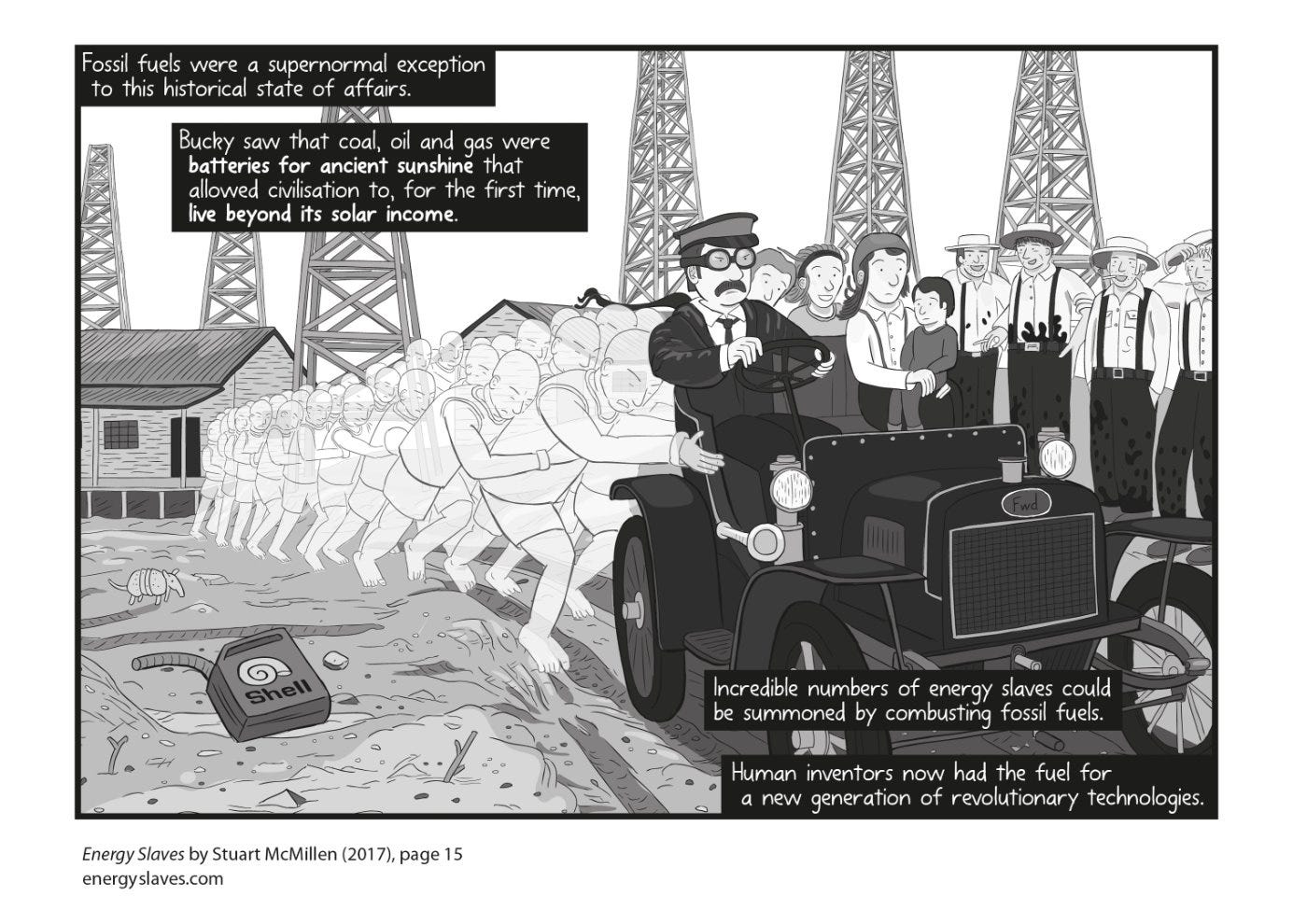
I’m really fond of the concept of energy slaves, and I want to credit Stuart for the image I used here. Buckminster Fuller coined this term in the 1940s, and an Australian named Stuart McMillen later produced a graphic novel that explains the concept brilliantly.
The idea is simple: think about the amount of human labour that would be required to do the work our energy system does for us — hence the image of many people pushing a car. The fossil fuel era gave those of us in the minority world an enormous multiplier of energy slaves. Any time we want to travel at speed, fly in a plane, or consume large amounts of electricity, we’re drawing on stored solar energy — essentially our inheritance from the past, or spending future generations’ inheritance. We are burning through ancient sunshine to power the speed of our economy.
Each of us uses somewhere between 100 and 600 energy slaves — or many more — depending on how much energy we consume daily. This concept came directly from the historical reality of human slavery, through which we multiplied productivity. We eventually decided that was a bad idea — though we should note that slavery still exists today. Then we switched to fossil fuels as our slave labour. And now, perhaps, we are sleepwalking into thinking renewable energy can simply replace that slave base, without thinking about the material impacts. Every renewable technology has material intensity — inputs that have to come from somewhere, be produced somewhere, and eventually become waste somewhere. Every time we talk about expanding renewable energy systems, we need to keep both sources and sinks in mind.
Pluriverse
A change of pace now — let me introduce the concept of the Pluriverse. How many people are familiar with this idea? I came across it during my PhD, which was on the impacts of mining on communities in Papua New Guinea.
The concept recognises that different cultures — non-Western cultures in particular — have fundamentally different ways of understanding and relating to the world. With the benefit of hindsight, we can see how the world’s many cultures and ways of being became colonised and replaced or dominated by Western ways of engaging with the world.
Pluriversality recognises a world where many worlds can co-exist — and where many do co-exist. There is a resurgence of interest in this, particularly coming from South America and from First Nations peoples globally, who are thinking about the world in very different ways from the dominant socio-economic system. Our planet is still home to many different worlds that have resisted the cultural homogenisation promoted by colonialism and imperialism.
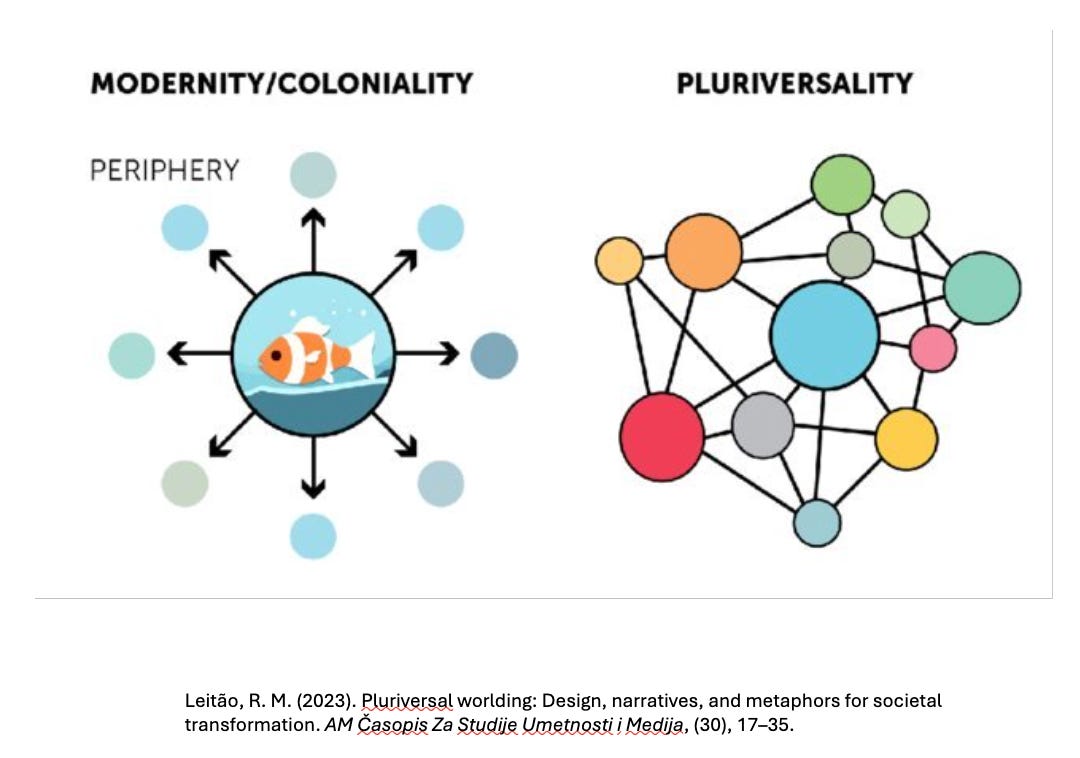
Pluriversality proposes a path for transformation built on the belief that alternatives to capitalist modernity are possible. It is focused on creating and nurturing new models of life, and reweaving our reality — not on destroying the old, but on recognising and making visible and viable alternatives that enable healthier relationships with nature and each other, particularly those created by indigenous and marginalised communities.
The key book here for me was Arturo Escobar’s Designs for the Pluriverse, which became a central part of my research and thinking about sustainability and the energy transition.
Ecocide and Genocide
I want to be clear: I am supportive of a renewable energy transition. We need it to happen. We just need it to happen in a way that is cognisant of existing problems — ones we can choose to address and improve during the transition, rather than ones we inadvertently make worse as we try to solve our energy problem.
Think about who is responsible for the energy crisis, and then think about where those with alternative worldviews are concentrated — among the poorest 80%, broadly speaking. The problem we created, and the solutions we in the West (the minority world) need to implement, must not adversely impact those with different lifestyles and different value systems.
Lemaire introduced me to the concept of atrocity in this context. Climate change, it can be argued, represents an atrocity in the same sense as any other act of mass harm — inaction at the scale we’ve seen qualifies. Lemaire extends this to ecocide, defined as unlawful or wanton acts committed with knowledge that there is a substantial likelihood of severe, widespread or long-term damage to the environment. Does anyone want to argue that that’s not what unmitigated climate change is?
Banwell takes it further still, adding genocide to the list, and also incorporating non-human entities. For those with a purely technical background, this might seem unusual — but it’s about the more-than-human: everything that’s not humanity. The environment. Processes. The geological diversity that underpins the world ‘we live in, it’s all of those things.
I raise this because I want the new system to be better. The energy transition needs to avoid atrocity and ecocide.
The Flow of Energy from South to North
Let me bring in some data. From 1990 to 2015, there has been a significant net transfer of energy from the global South to the global North. The numbers are striking: over $242 trillion in resources appropriated from the global South over that period, including 21 exajoules of energy in 2015 alone — enough, as Jason Hickel and colleagues calculate, to cover the annual energy needs of building out healthcare, housing, transport and sanitation for all 6.5 billion people in the global South.
Our current energy system allows for — and encourages — such flows. To return to the language of energy justice: we’ve extracted enough energy from the global South that could have done extraordinary things in the majority world. So not only do we need to create systems that stop this extraction — we have a debt to address.
This applies just as much to renewable energy as to fossil fuels. Whether it’s mining for lithium in Western Australia or Chile, or rare earths processing in Malaysia, we can still end up with the same transfer of resources. We just need to be aware of the justice issues involved, and make sure that the communities providing essential components of our renewable technologies are sharing in the benefits.
Lynas processing rare earths in Malaysia is a good example of what I’d call nearshoring that went on for more than a decade — out of sight, out of mind. It’s arguably positive that some of that processing is now returning home, because perhaps then we’ll be more responsible about the impacts. But we need to remain vigilant.
The broader point: by treating energy as an abstract quantitative unit, we wash away the qualitative violence, dispossession and ruin that occur as part of our socio-economic system.
What We Need
If the flows remain unequal, the transition will feed both our energy blindness and our geographic and justice blindness.
The only real path is an absolute reduction in energy consumption. The data from the IEA — hardly a leftist institution — shows accumulation of energy sources rather than a genuine transition. I would argue that reduction is best achieved by targeting luxury emissions in the minority world.
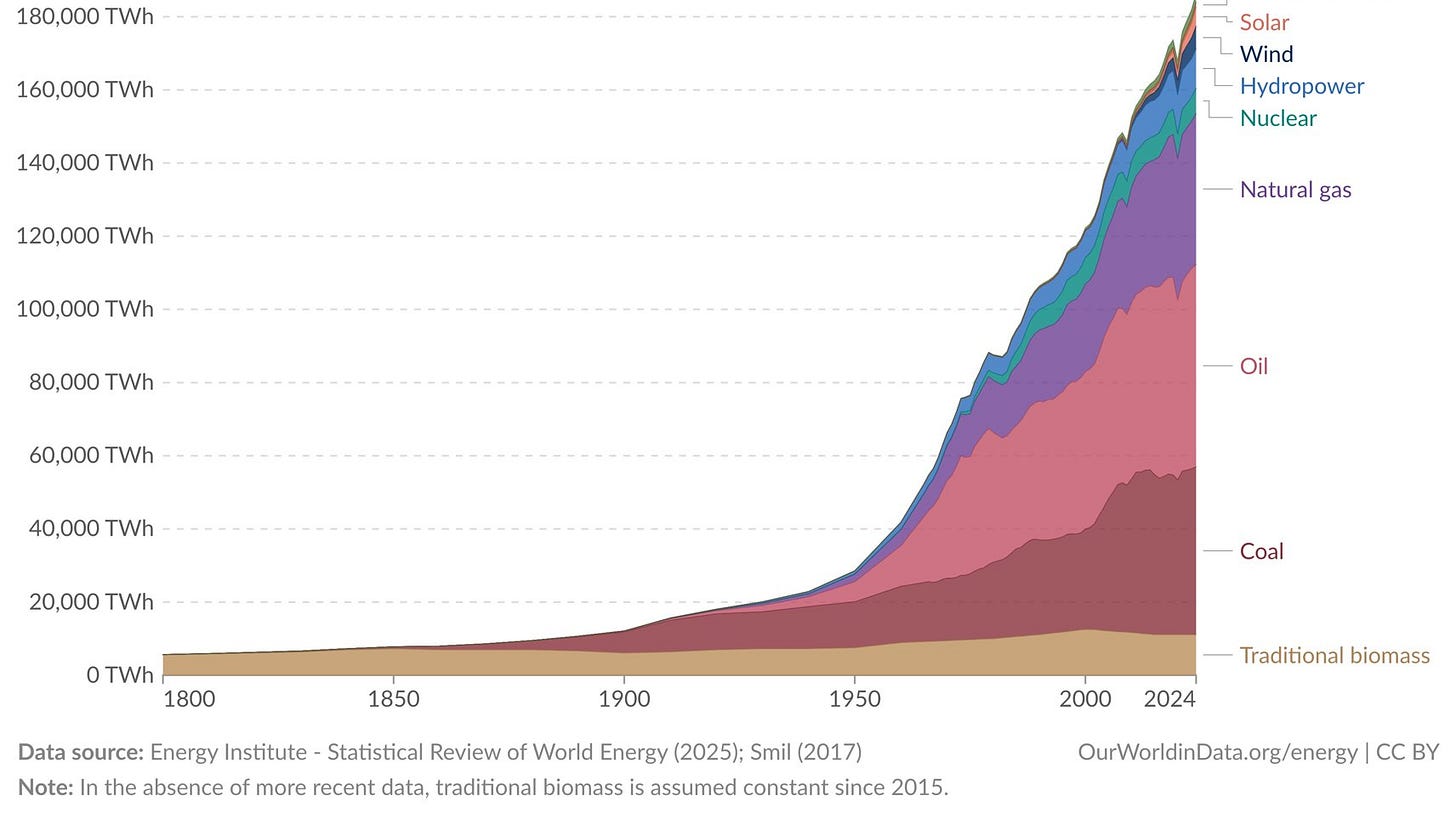
Did I really need to drive my car here today? Probably not — I had a workshop, which was my excuse, but I could have caught the train. It would have required a different relationship with the speed of modern society. And I think that question — do I need to do this faster? — is one worth sitting with.
Thank you very much.