
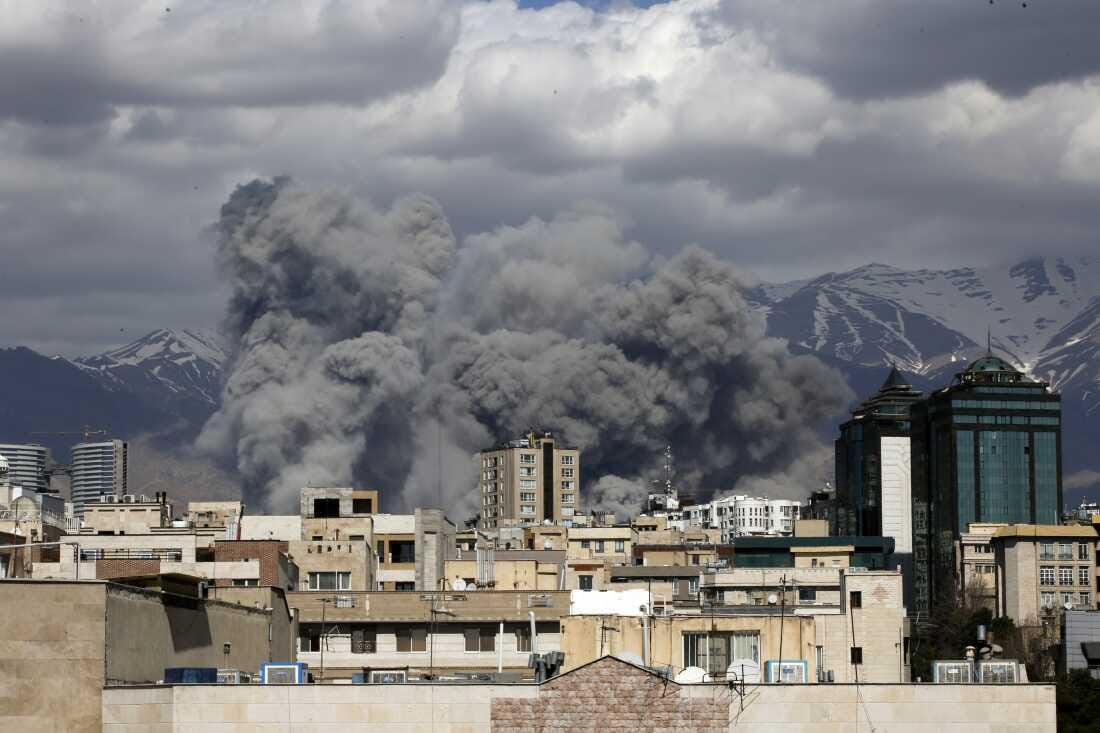
The joint military strikes conducted by the United States and Israel against Iranian infrastructure on 1 March 2026 have generated a deluge of analysis focused on immediate political catalysts: the breach of international law, the fragility of the Netanyahu government, the domestic pressures of the Trump administration, and the shifting tactical alliances in Western Asia. While these narratives provide essential context, we take a step back, examine this escalation through the lens of ‘atoms and bits’ (i.e. minerals, energy and information) and argue that the energy transition is a necessary condition for genuine sovereignty and sufficiency.
The driving argument presented here is simple: different sources of energy possess different qualitative features. Therefore, a world built on one energy source is fundamentally different from a world built on another—not just in its emissions, but in its physics of power.
While the strikes on Iran accurately describe a world built on the concentrated, targetable stocks of fossil fuels, we are beginning to see a different horizon. Moving toward renewable flows isn’t just a swap in ‘fuel’; it is a move toward a world that—by its very physical nature—favours democracy, sovereignty, and peace over imperial accumulation and domination. Or so we argue.
Our work often involves a critical interrogation of ‘greenwashing’ and ‘greenwishing’, we tend to highlight the eco-social costs and potential injustices of a poorly managed transition centred exclusively on growth. For example, in a recent article in The Conversation we argued that “getting rid of fossil fuels is really hard and we’re not making much progress”. This stance has, at times, led to our portrayal as ‘doom and gloom’ commentators—for example, colleagues have argued that such critiques may inadvertently lead to climate fatalism.
We acknowledge the concern that focusing on the shortcomings of the transition can feel like a dismissal of progress. Nevertheless, we are not interested in energy addition that perpetuates injustice—where renewables simply sit atop a growing pile of fossil fuels, feeding exponential energy consumption1—we are interested in a just energy transition that dismantles the mechanics of accumulation and therefore also of imperial dependency. To understand how this dependency is maintained, we look at the ‘imperial subscription model’ that currently holds the global economy captive.
The Imperial Subscription Model
The current global energy paradigm functions remarkably like the ‘techno-feudalism’ debated in digital economics, where users are reduced to dependent subscribers of infrastructure they do not own. Fossil fuels are the ultimate subscription service: a targetable stock that requires a perpetual umbilical cord to a centralised source.
The US-led energy dominance doctrine effectively treats hydrocarbons as a ‘drug’ that keeps the world on a leash. If fossil fuels are the hardware of this subscription, the US dollar—the petrocurrency—is the mandatory billing software. By requiring that energy stocks be traded in dollars, the hegemon ensures that every ‘refill’ reinforces the strength of its own financial architecture. To transition to renewables is to effectively allow this subscription to lapse, thereby severing the mechanism of imperial discipline.
Energy Stocks and the AI Arms Race
AI is now widely considered to be at the forefront of geopolitical calculations. Despite the idea that the digital world is ‘on the cloud’, it is entirely defined by a very real material and energy infrastructure. As OpenAI’s Sam Altman recently noted, the cost of AI will eventually converge with the cost of energy. In other words, winning the AI race is impossible without first winning the energy race.
In this context, the decision to target Iran—a producer of oil far cheaper to extract than viscous Venezuelan oil, or American shale—reveals the dependence of the US on energy stock monopoly (US oil producers have kindly offered to ‘help stabilise’ Iran). This is especially the case when China, the US’ main geopolitical adversary is itself heavily dependent on Iranian oil; in 2025, more than 80% of Iranian oil exports were destined to Chinese refiners. It consequently stands to reason that the US military apparatus is being deployed, at least in part, to secure a cheap energy subsidy for the fast-growing AI arms race while simultaneously gaining a choke point over its geopolitical rival.
By striking Iran, the US is actively integrating a rival stock into its own sphere of control—ensuring that the energy ‘drug’ remains under the management of Western capital while tethering the global economy more tightly to the dollar-denominated supply chain.
The Wrong Side of Energy History
There is a fascinating divergence in superpower strategy: while China has positioned itself as the world’s clean energy arsenal, the US is doubling down on being the world’s ‘gas station’. Aside from carbon and heat emissions, that strategy is a significant risk. According to the US Energy Information Administration, onshore wind and solar are the cheapest sources of new electricity generation ($18–$26/MWh), while natural gas costs more than triple that amount ($67/MWh).
Nations with $19/MWh electricity will simply be able to run three times more computational power than those paying $67/MWh. By clinging to expensive fossil fuels to protect traditional geopolitical leverage, the US may be committing the greatest strategic blunder of the 21st century—handicapping its own industrial competitiveness just as energy costs become the determining factor in global technological supremacy.
Nevertheless, we should concurrently recognise that this transition to renewables presents a fundamental contradiction for the US and other oil producers who profit from the $67/MWh prices. It also means that there is a profound conflict of interest at the heart of global energy policy. For the world, a high-Energy Return On Investment (EROI) transition to sovereign renewables makes perfect thermodynamic and financial sense. But for an empire built on the ‘imperial subscription model’, a high-EROI means reduced dependency and a threat to the bottom line.2
While the energy needs of AI likely drive much of the geopolitical and industrial policy we see today, we point to the fact that this drive is nonetheless a textbook example of the Jevons Paradox and the exponential growth of carbon and heat emissions. Under this lens, energy efficiency gains are not actually used to ‘transition’ or to reduce carbon and heat emissions. Instead, new sources of energy—both green and fossil—come to support exponentially growing energy dissipation. This is precisely what is cooking our planet: an increasing rate of entropy leading to ecological and social catastrophes.
The Deliberate Blockade on Renewables
One could argue that the US is merely buying time to secure its own transition, using fossil fuels as a bridging strategy. Yet, as Bill McKibben highlights in his latest dispatch, this doubling down on fossil fuels is better described as a deliberate blockade of the energy transition. The current US administration has effectively halted over 22 gigawatts of renewable projects on public lands—enough to power 16.5 million homes—while simultaneously injecting $3.5 billion in fresh subsidies into the fossil fuel sector.
This strategy only makes sense if we accept that the US is not merely fighting for energy security but for the preservation of its status as the global hegemon. Renewables, providing increasingly good EROI, being inherently decentralised and un-embargoable, offer no choke point for imperial control. By preventing the transition, the US presumably ensures that the main source of energy remains a targetable stock—a drug that everyone needs and for which the US holds the primary military leash.
A Shift in Temporality
Critics of this view often raise the mineral paradox, arguing that renewables merely swap one ‘drug’ (fossil fuels) for another (minerals), arguing that ‘critical minerals are likely to be the new oil’. It is indeed true that the infrastructure required to capture renewable flows depends on concentrated material stocks of minerals often controlled by China.
However, this objection misses a fundamental shift in temporality. While minerals are required for the upfront build, the ownership model of renewables provides a 20–25 year window of free and sovereign energy once the infrastructure is sunk. Unlike oil, solar does not require a tanker to arrive every week to stay functional. Once solar and wind capture is operational, the ‘fuel’ is free and cannot be sanctioned, embargoed, or blockaded.
Furthermore, unlike the linear ‘extract-burn-dump’ logic of fossil stocks, these minerals are inherently recyclable. By aiming for an ‘in-spiral economy’—where we build for material sufficiency and focus on re-mining existing tailings—we treat the ‘atoms’ of our infrastructure as a permanent, sovereign endowment rather than a depletable stock.3
This shift in temporality creates what we might call ‘political breathing room’—strategic horizons expand from weeks to decades. Capacity for genuine self-determination grows because peoples and nations are no longer hostage to the ‘managed chaos’ of global energy markets.
This is precisely why a hegemon might view flow energy as a threat. The U.S.’s active undermining of renewables can then be viewed as a strategic attempt to sabotage an alternative that offers ‘sovereignty by default’. For an empire built on the ability to turn the taps off, a world that doesn’t need taps is a world it can no longer control.
We Don’t Invade for Sunlight
As McKibben also notes, the strikes on Iran highlight a brutal truth: the country is both an easy and desirable target precisely because it sits on concentrated oil, which necessitates a centralised – and therefore targetable – infrastructure. Dependency on fossil fuels makes every oil-rich state a potential battlefield. Conversely, there is no strategic reason to invade or attack a country for its renewables. First, because flows like wind and solar energy are pervasive and decentralised, they can be captured anywhere and cannot be imported or exported. Second, they therefore also offer no ‘choke point’ for an aggressor to seize or blockade; as seen in Ukraine and Cuba, decentralised solar arrays are functionally ‘un-embargoable’ and nearly impossible to neutralise with conventional military strikes.
The Entropy of Empire: War is Waste
Finally, we should account for the thermodynamic cost of this pursuit of energy dominance rather than energy sovereignty. Warfare is the most heat-intensive activity in human history. Global military activity is the 4th biggest polluter after India but no reporting or reduction targets are required of the industry. The current strikes—along with those in Ukraine (311 MtCO2e), Gaza (32MtCO2e) and elsewhere in the world—release massive quantities of heat and greenhouse gases while destroying carbon sequestration capacity.
A more peaceful world is, by definition, a less entropic world. By moving away from a the stock paradigm of accumulation that requires constant replenishment leveraged for domination, we move toward a system of sufficient flows that is inherently more stable, peaceful and just.
The corollary of course is that the transition is a significant threat to the imperial status quo because it dismantles the very mechanism of geopolitical strangulation. It offers a path to a world where energy is no longer a tool of domination, but a resilient, sovereign flow that no empire can turn off.
Table: The Physics of Power (Stocks vs. Flows)
Conclusion: Sovereignty and Sufficiency
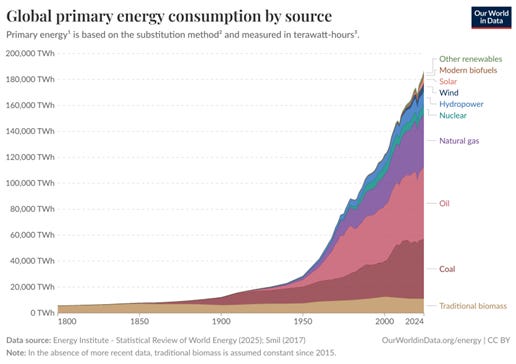
The current global energy transition is being subsumed by an arms race logic that dictates the exploitation of all resources—fossil, renewable, and mineral—to achieve absolute strategic dominance. In this race, ‘green’ energy is not used to reduce the planetary heat-load, but to expand the total volume of energy dissipation (see footnote #1). This is the techno-optimist logic that The Mining Monitor is often critical of, because it will inevitably disserve the planet regardless of the fuel source. We cannot simply assume that transition will happen simply by growing the supply of renewables; addition is historically and thermodynamically more likely if we do not plan and organise to prevent it. This is well demonstrated by the ‘graph of historical addition’:
However, by supplying an alternative and shifting our energy base from concentrated, targetable stocks to decentralised, unembargoable flows, we open up the possibility to dismantle the imperial logic of accumulation, domination, and of the arms race itself.
Justice requires a move toward sovereign sufficiency—the right of communities and nations to define their own energetic limits and ‘capture’ only what is necessary for a high quality of life. This requires a cultural shift, but, as this article argues, the material shift to renewables is a necessary condition.
Rather than competing to see who can burn the most to ‘win’ the AI race, we desperately need a coordinated capping of energy dissipation in a just and equitable manner. Ultimately, a genuine ‘just transition’ won’t be about who can accumulate the most energy in order to dominate others, but about who can live most richly within natural limits.
We use the term ‘consumption’ for reading ease, however, according to the first law of thermodynamics, energy is never actually ‘consumed’ or destroyed; it is only transformed from one state to another. Therefore, from a rigorous physical perspective, the term ‘energy consumption’ is a misnomer that obscures the actual process at play: dissipation. While the total quantity of energy in a closed system remains constant, its exergy—the portion of energy available to perform useful work—diminishes as it transitions from high-quality, ordered forms (like chemical bonds in fuel or electricity) into low-quality, disordered thermal energy. This irreversible slide toward equilibrium is governed by the second law of thermodynamics, which dictates that every energy conversion increases the total entropy of the universe. By shifting the vocabulary from consumption to dissipation, we better acknowledge that our economic and biological activities do not ‘use up’ energy, but rather degrade it into a diffuse, non-utilisable state, highlighting the physical limits of resource throughput in a finite system.
Energy Return on Investment (EROI) provides a physical, rather than just financial, critique of the current geopolitical escalation. While the ‘price per MW’ (financial cost) makes renewables look attractive, the EROI (energy profit) explains why the US is militarily anchored to stocks like Iranian oil despite their political cost.
Iran holds approximately 209 billion barrels of proven crude (3rd largest global reserves). Because this is conventional oil, its EROI is naturally higher and its extraction cost lower than US shale or Venezuelan heavy oil.
We use the term ‘in-spiral’ rather than ‘circular’ to acknowledge a fundamental thermodynamic truth: complete, 100% recycling is a physical impossibility due to entropic degradation. However, by building our infrastructure with a deliberate materialist foresight, we can ensure that minerals are captured and reused at the highest possible fidelity, significantly slowing the rate of primary extraction and extending the life of our ‘sovereign atoms’.