
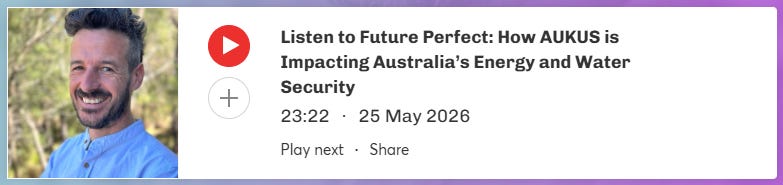
gwenaël velge’s new essay in Overland — Sacrificed for the Pentagon — and his interview on Triple R’s Future Perfect this week bring together a body of research that the Mining Monitor has been building piece by piece. This post introduces both, and situates them within the broader argument our work has been tracking.
The big picture is this: Australia is making sweeping, civilisational decisions about its place in the US military project with almost no democratic debate and very little expert oversight. In WA, we held four referendums on daylight savings, but communities get next to no say on how their land, forests and water are being exploited and degraded for the needs of the Pentagon. The integration with the AUKUS project military is already vast, and accelerating.
Our universities partner with arms manufacturers. Critical minerals are being extracted without environmental or community consent. Data centres proliferate across Perth’s eastern corridor — as we documented in The Cloud and the River — consuming energy and water with no regulatory framework in sight. And this week, the Premier announced that Western Australia wants to become an arms manufacturing hub, with the Collie transition package cited in the same breath. Communities promised a just transition from fossil fuels are being offered weapons manufacturing instead.
This is precisely the sustainability-security nexus that has written about — and Collie is its sharpest local expression.
None of this is new territory for the Mining Monitor. In Necessity Knows No Law, we traced how the US-Australia gallium deal is being used to fast-track decades of continued bauxite mining in the Northern Jarrah Forest, using national security as a lever to effectively override environmental law and community consent. In National Interest or National Deception? we showed how the Alcoa $55 million settlement was simultaneously framed as justice for one audience and a strategic “lock-in” of mining for another — the noise of the fine designed to mask the silence of the ‘national interest’ exemption. The Juice Media’s Honest Government Ad captured this inversion with characteristic precision.
The interview and essay also connect directly to the just transition and critical minerals debate that has been central to our work. Mia Pepper’s presentation at the World Renewable Energy Congress — Energy Transition, Critical Minerals, and Nature Protection in WA — showed that what is being sold as a transition is in practice more of everything: more gas, more mining, more industrial development, more emissions. Charles Roche’s What Does a Just Energy Transition Actually Require? asked the harder question: can an electrified version of the status quo really be a transition? And our Mining Policy Principles — developed with over a dozen civil society organisations — set out the non-negotiable red lines that any genuinely just transition must meet.
gwenaël’s Overland essay and Triple R interview are the latest contribution to this accumulating argument. The greatest threats to Australian (and global) security are not foreign adversaries, they are precisely what these policies manufacture and accelerate: climate change, the risk of nuclear or conventional war, and the degradation of our water and environmental security. We are making ourselves less safe in the name of safety, and doing so without being asked.
Listen to the interview. Read the essay. The architecture is conspicuous. It is up to us to say no and propose alternatives.