
As readers of The Mining Monitor know well, we have been challenging various narratives that tend to make extraction feel inevitable: rehabilitation, criticality, energy transition or even ‘record fine’.
For example, Alcoa’s $55 million ‘fine’ for unlawfully clearing 2,100 hectares of endangered species habitat. The ABC and The Guardian called it a record fine despite it representing less than 0.5% of Alcoa’s 2025 revenue. Meanwhile, Mining Magazine, presented the same ‘fine’ as locking in the future of bauxite mining in WA. In the same breath, Alcoa was granted an eighteen-months national interest exemption to keep clearing at the same pace while the government considers its expansion proposal and extension of operations until 2045.
On rehabilitation: after decades of operation, a single hectare remains yet to be officially recognised as rehabilitated and we know that removing the bauxite substrate removes the very conditions needed for that particular habitat to flourish.
On criticality: ‘critical mineral’ is a political economic construct more than a geological one, that should depend on what purpose, in what quantity a mineral might be needed, and what eco-social cost it might come at. Like all political economic matter, it should remain a matter of public scrutiny and decision-making.
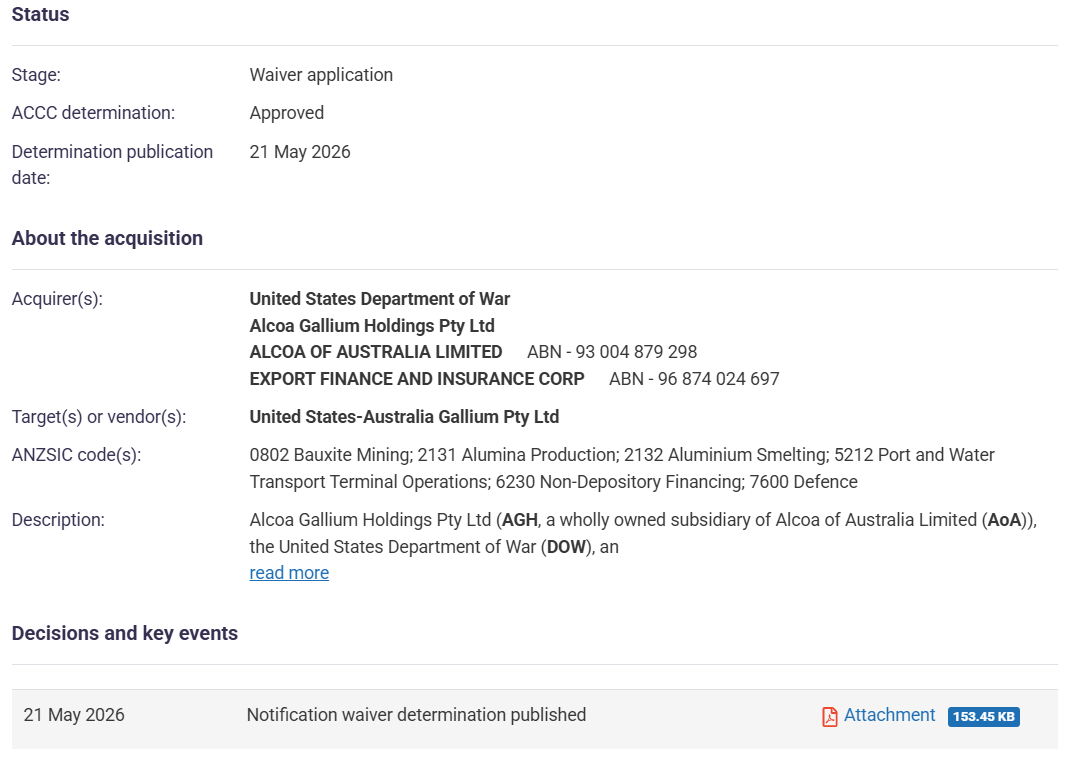
On transition: the gallium destined for Alcoa’s Wagerup refinery is funded under Title III of the US Defense Production Act, the mechanism that classifies Australia as a “domestic source” for US defence production. As our friends at The Wilderness Society pointed out to us, the gallium project at Alcoa’s Wagerup refinery is partly owned by the US Department of War. War is by design the highest-entropy human activity there is and the Us DoW is the main culprit. It is very hard to see how feeding it can ever count as decarbonisation.
Fifty-nine thousand submissions were made opposing Alcoa’s proposed expansion, the largest response ever received by the EPA. Yet the State Development Act and the EPBC Reforms provide enough discretionary power to override any obstacle in the way of the expansion, as long as the clause of ‘state interest’ gets mentioned at the right time.
Social licence for what, exactly?
That is the question the Mineral Policy Institute recently put in its submission to the House Standing Committee inquiry entitled “social licence and critical minerals”. Our main argument is that social licence shouldn’t be understood as a PR problem for the state and corporations to manage or purchase without serious and meaningful engagement with affected communities who should have the right to withhold consent.
What does social licence even mean when major deals such as AUKUS and the critical minerals US deal are made behind closed-doors? Further, the history of mining in this country highlights that the mining profits tend to be privatised while the costs are inevitably eco-socialised. MPI has shown that there are over 50 000 legacy mine sites in Australia, which makes promises of rehabilitation sound more like a way to get projects approved than something ever made to become a reality. And yet, we have also shown that these legacy sites can become meaningful opportunities for technospheric mining, if we prioritised it over new approvals.
Among our recommendations to the Committee:
– Enshrine Free, Prior and Informed Consent (FPIC) with right of veto in all mining and environmental legislation.
– Assess critical minerals through regional planning and cumulative impact — no fast-tracking, no preferential treatment.
– The critical minerals list should be assessed scientifically for its contribution to the energy transition, not private profit or foreign defence procurement.
– Prioritise remediation of the 50,000+ legacy mine sites before new approvals.
– Increase investment in technospheric mining — recovering minerals from what’s already been dug up, rather than digging up more.
– National interest exemptions must not be available for the commercial benefit of mining companies.
– Mining contracts should be made public and easily accessible.
(Full recommendations, including on environmental protection and alternatives, are in the submission — link)
When we prepare our submissions to inquiries, we mobilise the ‘red lines’ Mining Policy Principles that we co-designed and co-signed by a dozen Australian Civil Society Organisations. They are now easily citable (https://doi.org/10.5281/zenodo.17601765), published on the Zenodo repository. If you find yourself or your group using them, please let us know, we are currently writing an academic paper on the Principles and we would love to hear from you.
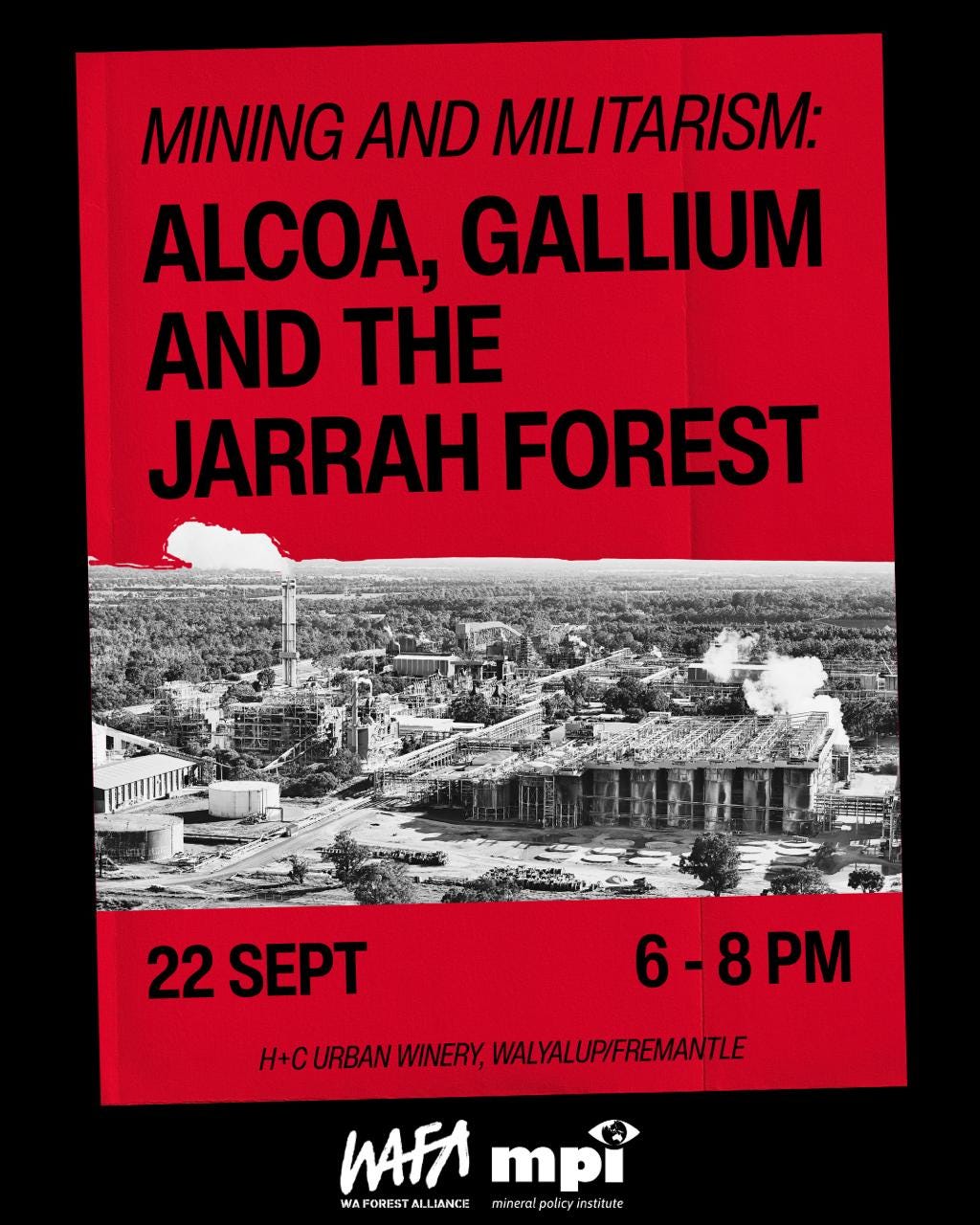
And if you want to hear more of this argument made out loud, MPI and the WA Forest Alliance are co-hosting a panel — Fighting Mining and Militarism: Alcoa, Gallium and the Jarrah Forest — on 22 September, 6–8pm, at H+C Urban Winery, Walyalup/Fremantle. Gwenaël velge from MPI will be on the panel
Keep up the good fight, the world needs you.