
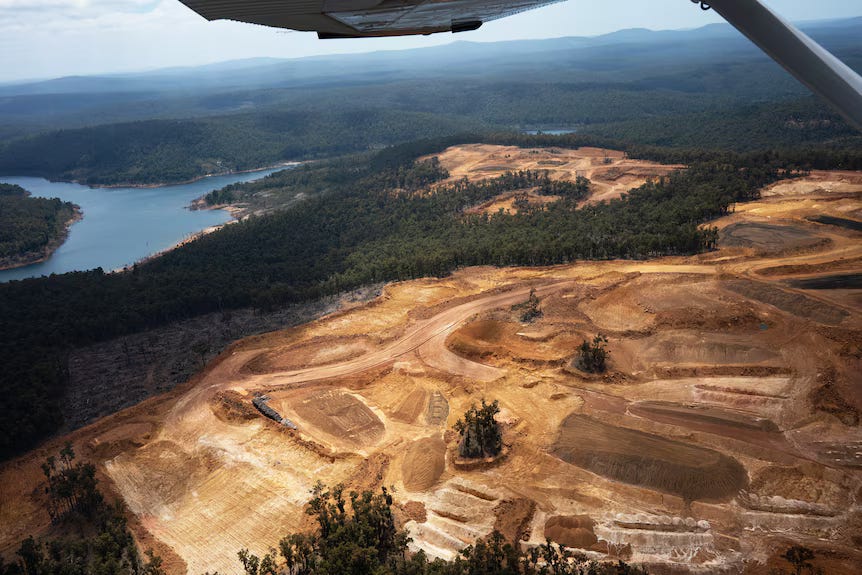
Yesterday’s announcement of the resolution of Alcoa’s environmental compliance issues in Western Australia provided a stark example of how linguistic framing and the selective mobilisation of discourse can bridge—or mask—the gap between irreconcilable expectations of justice.
Whether framed as a ‘punitive fine for illegal clearing’ (ABC, The Guardian) or as a ‘enforceable undertaking’ and ‘proactive investment in the energy transition locking-in the future for WA bauxite mines’ (Mining Magazine, DCCEEW), this $55 million ‘agreement’ presents itself as a green solution.
(We do not cover it here, but Alcoa’s South West operations are now framed through the lens of security and the energy transition via the mining of gallium, a critical mineral that is a byproduct of bauxite mining for alumina. For details, see here.)
However, unpacking these discursive strategies and contrasting them with material observations reveals a deep conflict between justice, corporate certainty, and a burgeoning ‘khaki’ strategic mandate.
A simple comparison, juxtaposing mainstream journalistic reporting (ABC, The Guardian) against industry-specific media (Mining Magazine) and government communications highlights the functional discrepancy that allows the extractive system to reproduce itself undisturbed.
By examining how the same event is packaged for different audiences, we can identify what is highlighted as essential and what is papered over. This approach reveals how strategic framing—such as the superficial use of ‘defence industries’, ‘modernisation of approvals’ and ‘green transition’—is used to harmonise conflicting interests, even when such framing obscures significant risks to national sovereignty, environmental security and the energy transition.
The Legal Sleight of Hand: ‘Undertakings’ Matter
Why does the government speak the language of ‘undertakings’ rather than ‘prosecution’? In the grammar of Australian environmental law, an enforceable undertaking is a voluntary, legally binding agreement that acts as a ‘peace treaty’. It allows Alcoa to acknowledge historical clearing without a formal admission of guilt or a criminal conviction.
For the Minister, it provides a claim of ‘restorative’ victory by directing the $55 million toward popular conservation projects—like black cockatoo habitats—rather than letting the ‘fine’ disappear into general tax revenue. Most crucially, as Mining Magazine makes clear, it buys the operational certainty required to keep the extraction engine running uninterrupted now and into the future. It transforms a massive regulatory breach into a collaborative strategic milestone, that is the power of discursive framing.
The Conflict of Expectations: Three Dimensions of Justice and Reproduction
To understand the Alcoa event, we must look at the specific justice frameworks and modes of reproduction driving each stakeholder:
The Public: Procedural and Distributive Justice (Sustainable Reproduction): The 59,000 public submissions demonstrate an expectation of procedural justice—that laws like the EPBC Act should be applied equitably.
For the community, the goal is sustainable reproduction: the long-term health of the Northern Jarrah Forest and the security of Perth’s water supply. To this group, the clearing of 2,100 hectares represents a failure of distributive justice, where ecological risks are borne locally while profits are exported. Within this expectation, serving Alcoa with a fine, as reported by the ABC and The Guardian, performs a symbolic function: it suggests the ‘rule of law’ is protecting the conditions of life.
The Corporation: Contractual and Commutative Justice (Profit Reproduction): For Alcoa, the goal is profit reproduction. Capital generally rejects ‘restorative’ or ‘distributive’ frameworks as they introduce open-ended social obligations. Instead, it operates under commutative justice (the justice of the exchange). In this logic, justice is served when the terms of a ‘deal’ are met: Alcoa pays $55 million (the price) in exchange for 18 months of clearing (the product).
For capital, profit is generated through forest loss. Eco-social injustice cannot be avoided if profit is to be made, instead it must be managed contractually. Under this lens, (in)justice is reframed as commutative and it occurs when community sentiment interferes with the signed agreement which defines the boundaries of the ledger (profits in, eco-social damage out). Any social or ecological cost (now or in the future) is framed as a necessary ‘externality’ (i.e. outside the ledger)—the mechanism by which profit is privatised and ecological debt is socialised.1
The Government: Pragmatic Utilitarianism (Political Reproduction): The government’s framework functions as a translation layer driven by the needs of political reproduction. Minister Murray Watt has framed the deal as being “in accordance with environmental law,” a phrase that seeks to bestow a veneer of procedural legitimacy on an extraordinary intervention that the Biodiversity Council calls a “dangerous precedent”. In practice, this mediation functions as a form of securitised (Snell, et al., 2025, Beeson, et al., 2025) and justice-washed (Titifanue, 2025) utilitarianism: via the gallium project, the state argues that the energy transition and the survival of a strategic alliance outweighs local distributive, restorative and procedural justice.
The Minister relies on procedural justice not to ensure a fair outcome in which expertise and the people are heard, but to validate a legal-contractual process. By following the ‘procedure’ of an ‘enforceable undertaking,’ the government can claim the system is working, even as it facilitates the very clearing that environmental law and the community oppose. Historically, ‘national interest’ exemptions were reserved for acute emergencies; here, it is used for the retrospective regularisation of unauthorised clearing and the protection of industrial production.
This pragmatic utilitarianism is further codified in the recent passage of the State Development Act 2025 (WA) and the EPBC Act reforms. These legislative shifts concentrate discretionary power in the executive, allowing the Premier and Federal Minister to designate projects as ‘strategically significant’ or in the ‘national interest’, thereby making way for fast-track pathways that effectively override the standard checks and balances of the Environmental Protection Authority (EPA) and local community consultation frameworks.2
To put the claims of justice and reproduction into material perspective, we can begin with Alcoa’s claims and track record.
According to Alcoa’s own operational commitments, the company will continue to limit clearing to 800 hectares per annum. Under the 18-month ‘national interest’ exemption, this allows for the clearing of a further 1,200 hectares of the Northern Jarrah Forest while the strategic assessment is conducted—nearly 60% of the 2,100 hectares for which they were just ‘penalised.’
Further, while the company pledges to ‘rehabilitate’ 1,000 hectares per year by 2027, the scientific reality is far grimmer. After six decades of operations, not a single hectare of mined land has been formally certified as ‘completed’ by the WA government. This is not (only) a failure of effort, but of substrate: the Jarrah forest is not a crop that can be replanted on crushed rock. By removing the bauxite substrate—the very foundation of the forest’s ancient hydrological and nutrient systems—the mining process renders the ecosystem non-rehabilitatable. What the government and Alcoa frame as ‘rehabilitation’ is, in truth, a thin veneer of green sprayed over a sacrifice zone, a mask designed to hide the permanent loss of one of Earth’s most biodiverse regions.
The ‘Khaki’ Shield: Superficial Framing and DPA Title III
Additionally to the three actors reviewed above (the public, Alcoa and the Australian government), the government must also mediate with the interests of other states, especially the US. Federal communications explicitly reference ‘defence industries’ and the needs of ‘allies’ like the US and Japan. The government thereby frames ‘defence’ as a positive-sounding signifier for ‘national interest,’ but it avoids the confronting mechanics of the deal.
As Greens MP Jess Beckerling stated, it is “staggering to read that Alcoa has been clearing illegally since 2011, that the department has been informing Alcoa of its obligations since that time, but that no penalty has been imposed until now”. We may wish to ask what has changed.
The government acknowledges, but papers over the fact that the new gallium recovery project – which provides both the ‘green’ and ‘khaki’ justification for the Alcoa’s National Exemption – is funded under Title III of the US Defense Production Act (DPA).
Domesticating Australian Resources: DPA Title III effectively classifies Australia as a ‘domestic source’ for US defence production. By acknowledging ‘defence industries’ without explaining this ‘domestic source’ classification, the government internalises the US military-industrial complex into Australian environmental policy under the cloak of allied cooperation.
The Strategic Trump Card: Linking bauxite to gallium for US hardware allows the unprecedented ‘national interest exemption’ to bypass local environmental concerns. The discourse uses defence as a rhetorical shield; it sounds like a sovereign priority, while in reality, it may be the opposite: a subordination of local water and forest security to the procurement needs of the Pentagon.
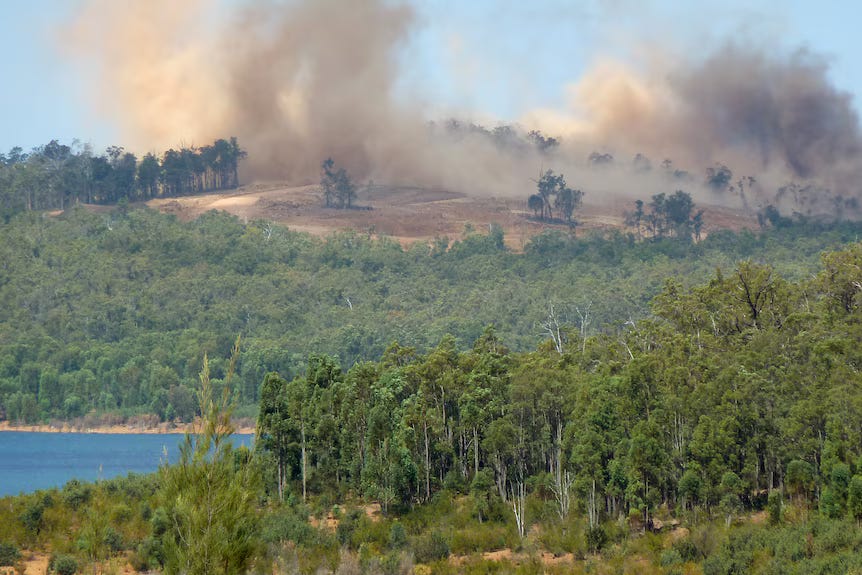
A critical pushback against this ‘khaki’ framing comes from within the discipline of military security itself.
Scholars such as Mark Beeson, Emma Shortis, and Hugh White warn that US security needs are often at odds with Australia’s. White argues that Australia’s pre-emptive capitulation ignores the transactional nature of alliances—the US could drag us into armed conflicts they are not themselves willing to fight. These critics suggest that by becoming a ‘domestic source’ for the US military, Australia is ‘painting a target on its back’ while simultaneously failing to meet the genuine challenges of the energy transition.
The Function of Discrepancy: Defuse Critique
It would be a mistake to view these two narratives—the ‘punitive fine’ and the ‘strategic agreement’—as a failure of communication. On the contrary, the discrepancy is the very mechanism by which the system perpetuates its logic.
By framing the event primarily through a narrative of accountability (the $55 million settlement), mainstream reporting often inadvertently exhausts the public’s appetite for dissent. This raises a critical question regarding the function of media framing: what would the public’s reaction have been had the reporting mirrored industry-focused outlets like Mining Magazine, which described the event as Alcoa ‘locking-in the future’ of its WA bauxite mines, rather than a ‘record-breaking fine’? According to the Biodiversity Council, this $55 million represents less than 0.5% of Alcoa’s 2025 revenue—and, according to this author’s back of the envelope calculations, only 0.047% of the total revenue generated during the 2019–2025 period in which the unauthorised clearing occurred.3 As the Council notes, such a figure “may not even exceed what they would have spent on environmental rectification and offsets had they sought approvals” in the first place.
This ‘record-breaking fine version’ ends up serving the ‘lock-in agreement version’ by defusing critique in advance. Once the public believes justice has been served through a record penalty, the subsumption of the forest into a ‘green’ and ‘khaki’ strategic mandate can proceed as a quiet, administrative inevitability. The noise of the fine is designed to mask the silence of the exemption.
Conclusion: The Real Cost of the System
The Alcoa agreement is a demonstration of the system working exactly as intended. By segmenting its discourse, the state allows a multinational corporation to pay a symbolic price—a $55 million ‘settlement’ that appears in some news cycles as a penalty and in others as a ‘lock-in’ strategic investment. This price, while record-breaking in headline terms, is ultimately a manageable (and discounted) operating cost for a ‘domestic source’ of critical military minerals for the US and long-term guaranteed access to high-grade bauxite for Alcoa.
However, the real price is not paid by Alcoa or the US Department of War, but by the people of Western Australia, the Northern Jarrah Forest, and the long-term viability of the planet. While the public is pacified by the theatre of a fine, the environment pays through the loss of 2,100 hectares of biodiversity and the multigenerational degradation of water security for the Perth region. By prioritising the ‘khaki’ needs of a foreign military-industrial complex over regional ecological sovereignty, the discourse of the ‘just transition’ has been effectively colonised to justify not just a temporary breach, but a permanent state of extraction. In this exchange, the corporation secures its growth, the US military secures its supply, yet the environment and the people are left to absorb the externalities of a transition that is neither just nor truly green.
Disclaimer: This article constitutes a socio-legal and discourse analysis based on publicly available government documents, ministerial statements, and corporate financial reports. The views expressed regarding “justice frameworks” and “strategic subsumption” are the author’s academic opinions based on the documented facts of the February 2026 Alcoa settlement.
The boundaries of the ledger or the contract contrast directly with the idea of planetary boundaries, which by definition include the eco-social and thermodynamic cost(s) of extraction.
Interesting twist: while the clearing was illegal under the 1999 rules, the December 2025 EPBC reforms specifically closed the loophole Alcoa was hiding behind for years. The old law had a ‘murky grey zone’ that allowed companies to self-assess their need for federal approval. Alcoa argued that because their mining leases began in the 1960s, they didn’t need to follow the national environmental laws established in 2000. The Federal Environment Department warned Alcoa for 15 years that this interpretation was incorrect and that clearing habitat for protected species (like black cockatoos) required federal approval. The new law (Dec 2025) explicitly states that ‘continuous use’ exemptions (Sections 43A and 43B of the original EPBC Act) do not apply to clearing native vegetation. This change meant Alcoa could no longer maintain their legal dispute. They were forced to admit that their ongoing clearing was unauthorised, which led to the ‘record’ $55 million penalty announced on 18 February 2026.
While the Federal Environment Department has maintained that Alcoa’s clearing was unauthorised since at least 2011, the enforceable undertakings only cover the 2,100 hectares cleared between 2019 and 2025. By focusing on this window—justified by the six-year statute of limitations and the availability of high-resolution satellite evidence—the settlement effectively clears eight years of prior departmental warnings into a historical amnesty. This reflects a strategic legal compromise that allows the corporation to ‘clean the ledger’ before transitioning into its new National Interest Exemption.