
The Bajau are losing the sea
The MPI team is currently researching the material and justice impacts of the Majority World’s demand for batteries. While researching lithium mining in Chile, cobalt mining in the DRC and nickel mining in Indonesia. Kabaena Island emerged as an illustrative case study in extractivism.
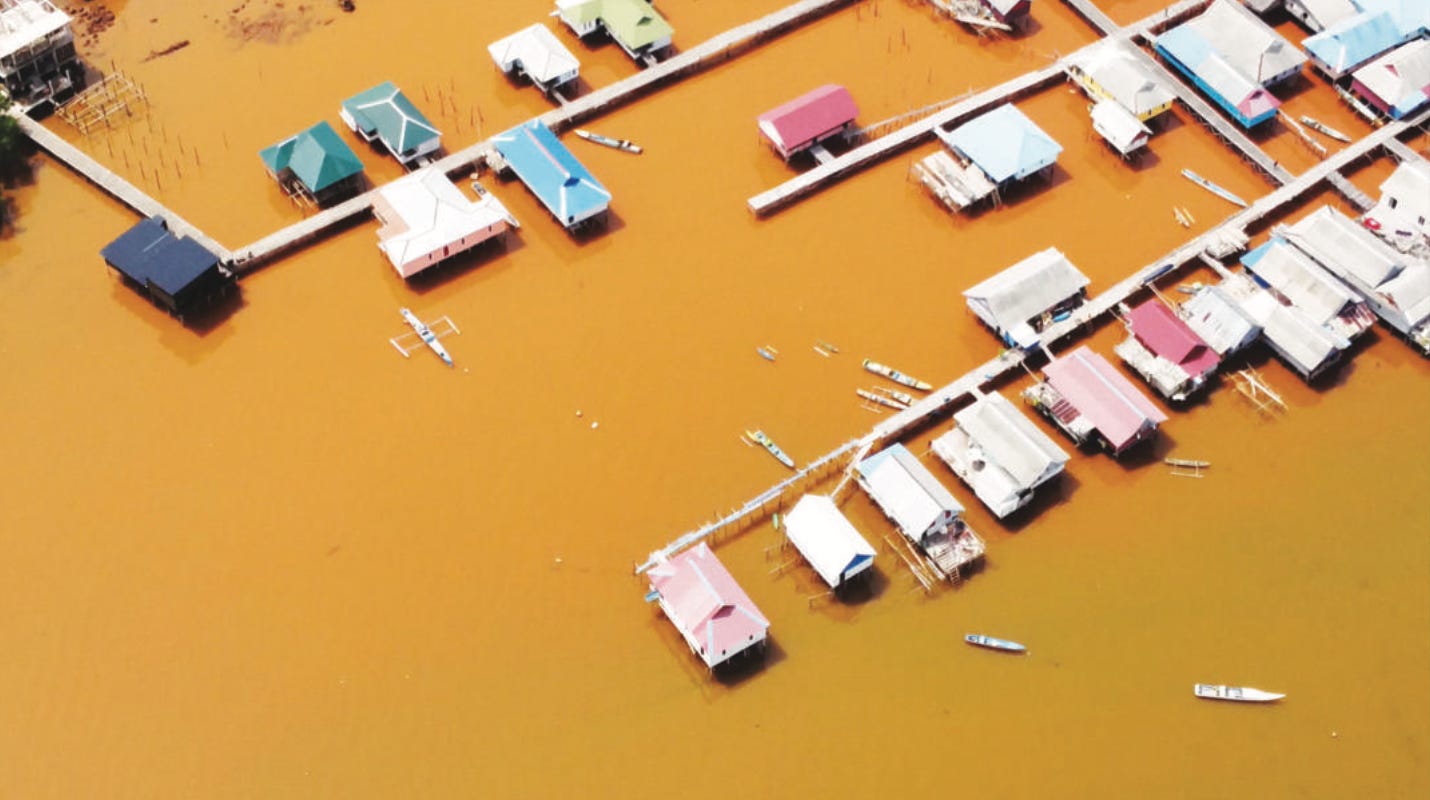
The Bajau people of Kabaena Island in Southeast Sulawesi have organised their daily existence around the ocean for centuries. They free-dive to thirty metres without breathing equipment, live in stilt houses built over coastal water, and subsist through fishing and the gathering of marine resources. This aquatic life has resulted in physiological adaptations — measurably enlarged spleens — over generations. Parents teach their children to swim before they can walk.
In 2006, significant nickel deposits were identified on the Island. Within two decades, approximately 73% of Kabaena’s total land area — an island of just 891 km² — had been allocated to mining licences. The consequences are extensively documented in research by Satya Bumi (see pdf below) and others: rivers running red with sediment, coastal waters thick with mining waste, fishing grounds destroyed, the sea floor smothered. Parents now forbid their children to swim. The Bajau are losing the ocean that made them.
Nickel is a critical mineral — essential for electric vehicle batteries and multiple other applications across the energy transition. The mining on Kabaena does not happen despite the green energy transition; it happens because of it. The battery narrative provides both the market demand and the political cover. Yet this green framing conceals something the empirical record makes clear: Indonesia’s nickel boom is powered substantially by coal, and the transition narrative has in practice supported continued coal extraction rather than replacing it.1 This is consistent with what the historian Jean-Baptiste Fressoz has shown about energy transitions more broadly — they have always been additions, not substitutions. Nickel-for-batteries does not replace the fossil fuel economy. It runs on top of it, while providing the story that makes the whole apparatus legible as progress.
The conventional framing — wealthy corporations exploiting a weak state — contains truth but misses something important. This extraction happened in explicit violation of Indonesian law. Law Number 1 of 2014 prohibits mining on islands smaller than 2,000 km². Kabaena is 891 km². The law wasn’t ambiguous. It wasn’t unknown. It was overridden.
Research by Wijaya and Sinclair (2024) on the Indonesian nickel industry shows that the actors driving extraction are not primarily or exclusively Western multinationals. Significant Indonesian involvement includes Indonesian coal conglomerates providing the infrastructure and political access, and the Indonesian state providing regulatory cover and national development framing. These aid foreign battery manufacturers and car companies — Chinese, Korean, Japanese — by providing capital and the cover of green transition legitimacy. Each needs the others, all operating under the protective cover of the energy transition. The extraction continues; the commodity changes; the communities bearing the cost remain the same.
The same logic, in Australia’s South West.
Six thousand kilometres south, on Noongar country, in the South West of Western Australia, a different community is also losing its water.
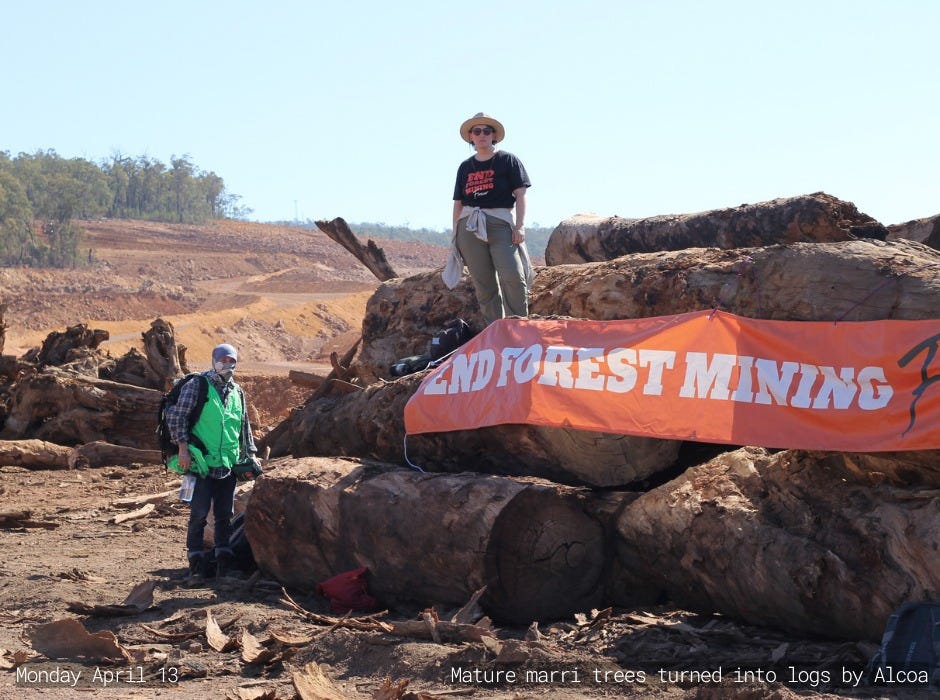
The Northern Jarrah Forest sits above the catchments that supply Perth’s drinking water. The Noongar people have lived in relationship with this country for tens of thousands of years — its rivers, its ancient hydrological systems, and the forest floor. For sixty years, Alcoa has been strip-mining bauxite from this forest. After sixty years of operations, not a single hectare of Alcoa’s mined land has been formally certified as rehabilitated by the WA government. The bauxite substrate is the geological foundation on which the Jarrah forest’s ancient hydrological and nutrient systems depend. Once removed, it cannot be restored — and neither can the forest above it. What is called “rehabilitation” is, more accurately, described in the scientific literature as a permanent conversion. A sacrifice zone, described in the language of restoration.
The WA Water Corporation — a state-owned entity — has stated that the probability of contamination of Perth’s reservoirs from Alcoa’s operations is “certain.” An Alcoa-commissioned analysis found its own expansion plans pose a “high risk” to the drinking water of 2.3 million people. The Bajau are losing the sea. Perth is losing its water. The forest communities of the South West are losing the land that filters and creates clean water.
The same logic operat at different points on the same supply chain.
What is corruption?
While injustices are perpetuated in both locations, a Western audience might still reflexively respond with a familiar reaction: framing the first as a governance failure, and the second as governance.
Yet, as we argue here, the documentary record should make us more alert to the different forms of extractivism and undue political influence.
In 2017, Nur Alam — the Governor of Southeast Sulawesi, whose province includes Kabaena — was arrested, tried, and sentenced to twelve years in prison. His crime was corruption in the issuing of mining permits: he had personally profited from licences he granted to nickel mining companies. The permits enabled the destruction. The corruption was in the transaction. He went to prison for it.2
Now consider Western Australia. Alcoa has been clearing habitat for nationally protected species in the Northern Jarrah Forest without seeking approval under the federal Environment Protection and Biodiversity Conservation Act since at least 2011 — maintaining throughout that it didn’t need to even as environment officials warned Alcoa it did. In February 2026, a settlement was reached. Alcoa paid AUD $55 million — described in mainstream media as a “record fine.” The figure represents less than 0.5% of Alcoa’s 2025 revenue, and approximately 0.047% of total revenue generated during the period of unauthorised clearing. As accurately reported by Mining Magazine: “Alcoa locks in future for WA bauxite mines.” No individual executive faced criminal charges. No government official faced any consequence for fifteen years of non-enforcement. The clearing continues at 800 hectares per year — more than all mining leases on Kabaena combined — under a “national interest exemption.”
Mark McGowan spent six years as Premier keeping conflict with the mining industry to a minimum — green-lighting BHP’s century-long Pilbara expansion, launching formal investment partnerships with BHP, MinRes, Rio Tinto and others, and tolerating Alcoa’s illegal clearing without penalty. Within months of leaving office he was advising BHP and Mineral Resources, the companies he had just regulated. As Crikey titled it: “Mark McGowan has been auditioning for his new mining job for six years.” This is legal. It is described as “private sector experience.” And yet, scholars describe such behaviour as “state-corporate crime” associated with significant social and environmental harms.
The question “which of these two systems is most corrupt” deserves a serious answer rather than a dismissive colonial reflex. A system that imprisons the permit-issuer is, in at least one meaningful sense, more accountable than a system that gives the permit-issuer an advisory seat. The form of corruption differs — Nur Alam’s was illegal, transactional and visible; whereas the revolving door is structural and normalised. But the substance — regulatory capture, private profit from public resources, environmental cost socialised onto communities — is functionally identical.
None of this is new. WA has been a mining state for over a century. The procedural cover — environmental review, community consultation, regulatory oversight — was always partial, always contested, always more reliable for some communities than others. And yet, something new is unfolding. The formal cover is now being legislated away rather than merely tolerated in its breach. The state is moving from looking the other way to changing the law so there is nothing to look away from.
The procedural cover is removed — and resistance is criminalised
The Alcoa settlement is not the end of the story. It is the mechanism by which the next chapter is made possible.
In August 2025, 59,000 submissions from the local community were submitted to the EPA regarding Alcoa’s expansion into the Jarrah Forest. It was the first EPA review in the company’s sixty-year history in WA. Alcoa’s original state agreements predate the Environmental Protection Act — a shield from independent oversight that had held for six decades. Yet, in October 2025, as we documented in detail in “Necessity Knows No Law,” the United States and Australia signed a Framework for Securing of Supply in the Mining and Processing of Critical Minerals and Rare Earths. Under Title III of the US Defense Production Act, Australia has been administratively reclassified as a “domestic source” for US defence production — incorporated into the US military-industrial supply chain with the environmental and social costs borne locally while the strategic benefit accrues elsewhere.
This reclassification has a direct domestic consequence that goes beyond fast-tracking permits. Australia has made commitments to Washington — on gallium production timelines, on supply chain security — that cannot be honoured while normal regulatory processes run their course. The EPA review, the community consultation, the standard environmental assessment: these are not merely inconvenient. They are structurally incompatible with the obligations already signed. The procedural cover is not being removed because someone decided accountability was optional. It is being removed because Australia’s vassal status makes it impossible to maintain.
The State Development Act 2025 (WA) and concurrent EPBC Act reforms — analysed in “National Interest or National Deception” — concentrate discretionary power in the executive, allowing the Premier and Federal Minister to designate projects as “strategically significant” and effectively override the EPA and community consultation. Speed and strategic necessity are stated openly as taking precedence over regulatory process. The arms race logic of national security, compounded by the competitive pressure to extract faster than rivals, makes any procedural friction a strategic liability. Any check or balance becomes obstruction. This is not the procedural system failing. It is being openly dismantled.
But procedural removal generates resistance. And resistance, in this logic, generates its own escalation. The WA Labor government adopted Queensland-modelled anti-protest laws in 2024 — part of a wave of state legislation across Australia that has seen protesters facing fines and imprisonment for disrupting mining and resource operations. The Cook government is currently advancing a Public Order Legislation Amendment Bill 2026. A University of Bristol study (2023) found Australia leads the world in arresting climate and environment protesters.
The parallel with Kabaena is, once more, structural not metaphorical. On Kabaena, police accompany every ore extraction operation, and communities report the criminalisation of protest as systematic. Indonesia’s Mining Law Article 162, passed in 2020, has been used to arrest villagers and activists opposing nickel mining across the archipelago — described by environmental groups as “a devious policy used to eradicate people’s participation.” In October 2025, eleven indigenous people in the North Maluku nickel belt were sentenced to prison for protesting mining on their ancestral land. Climate Rights International called it “shameful that people protecting their forests and rivers are treated as criminals while those destroying them are left untouched.” The Indonesian state did not fail to protect these communities. It actively built the legal infrastructure to silence them.
The legislative trajectory is similar: fast-track the extraction, remove the procedural obstacles, criminalise the communities that resist. Each step makes the next one necessary. What differs is the speed, the degree of implementation, and the press releases accompanying each step.
Geographic invisibility
There is a structural geography that tends to keep both forms of destruction invisible to those who benefit from them. For Kabaena, the “elsewhere” is obvious: the island is remote, the Bajau are marginal to Indonesian political life, the harm is geographically distant from the cities and consumers who benefit from cheap nickel. For Alcoa’s operations in the South West, the “elsewhere” operates more subtly but identically: the forest clearing happens in the “regions,” Perth receives some of the economic benefit of the industry, and the likely contamination of its water supply is a future cost that has not yet arrived visibly enough to disturb the present political settlement. The regions are the Global South of Western Australian political economy — present in the revenue figures, but mostly absent from the deliberative life of the city.
In 1991, Lawrence Summers — then chief economist of the World Bank — wrote a memo that named this logic with unusual candour:
“Just between you and me, shouldn’t the World Bank be encouraging more migration of the dirty industries to the LDCs (Least Developed Countries)? I think the economic logic behind dumping a load of toxic waste in the lowest wage country is impeccable and we should face up to that…. I’ve always thought that underpopulated countries in Africa are vastly underpolluted; their air quality is vastly inefficiently low compared to Los Angeles or Mexico City.”
The memo was leaked. There was outrage. Summers said it was ironic. What he articulated was not a policy proposal. It was a description of how the world already worked, and had worked for a long time: move the harm to where it cannot be seen, where the people bearing it have no political voice, where their suffering registers as an economic opportunity rather than a scandal.
Summers was describing the global economy. But the logic he articulated scales. It does not only operate between nations — it operates within them as well. Western Australia is not a least developed country. But its regional communities bear the cost while the benefits flow to the capital cities. The “elsewhere” is always constructed relative to where power sits, not only relative to GDP per capita. Kabaena is elsewhere to Jakarta. The Northern Jarrah Forest is elsewhere to Perth.
If anything, under the logic of national security, Summers’ memo is considerably more acceptable today than it was in 1991 — despite the decades of UN resolutions, education and advocacy on colonialism and global warming. This is not a new development. It is a structure that has always been present, its acceleration under competitive pressure, and the fraying of even the partial procedural cover that once made it less visible.
That spatial management is now being further compressed. Data centres are bringing the extractive infrastructure into the city itself: the water consumption, the heat, the energy demand, the land use. This is not extraction arriving somewhere new. It is the cost structure of an extractive economy becoming visible to people who previously only received its benefits — people with lawyers, votes, and media access. The spatial buffer that managed whose suffering was legible is thinning. The “elsewhere” is running out of room.
One struggle
The conventional solidarity frame available to Western readers encountering a story about the Bajau is familiar. We are invited to feel moral concern for a distant community. We may donate, sign petitions, share articles. The frame positions the Western reader as a moral agent who can judge or extend solidarity, with the Bajau as recipients.
Such a frame reproduces the colonial structure it claims to oppose.
This needs to be said carefully because there is a predictable misreading available. This is not a claim about equivalent suffering — the harms documented here fall very differently on different communities. It is a claim about shared mechanism and shared standing: every community subject to negative impact has the right to name it and resist it, regardless of where they sit in the hierarchy of harm. And when extraction becomes visible to those who have benefited from its distance, it does not equalise the suffering — it removes the excuse for not seeing it.
Australia’s reclassification as a “domestic source” for US defence production under Title III of the Defense Production Act is the sharpest version of this argument. White Anglo-Saxon Australians are now, in this limited but material sense, also living in a subordinated territory: one whose environmental sovereignty has been signed over to President Trump’s whims and to the Pentagon procurement requirements. The Summers logic — direct costs toward the lowest-resistance jurisdiction — is being applied to an ally.
This must be held alongside, not used to displace, a prior and ongoing colonisation. The Noongar people’s country is where Alcoa operates. The water being contaminated is on Noongar land. Indigenous Australians have been subject to colonial extraction for 250 years and continue to bear its costs most severely. The layers do not cancel each other. They compound. Australia is simultaneously a settler colonial state that continues to dispossess First Nations peoples, a middle power that has historically benefited from the US-led order, and now, a subordinated territory within that order. The Noongar elder opposing Alcoa’s expansion, the Bajau fisher watching the sea floor smothered, and the Perth resident discovering their suburb is a sacrifice zone for data centre water consumption are all, at different registers and with vastly different degrees of harm, encountering the same extractive logic. The harms are not equivalent. The structure is.
Nur Alam went to prison. Mark McGowan went to work for mining. Alcoa’s executives went to their next earnings call. The Bajau children no longer get to swim. Jarrah Forests and endangered black cockatoos are furtehr threatened and diminished. Perth’s water gets contaminated by mining and consumed by data centres.
The brazenness is not somewhere else, in the future. It is here — it has always been here — administered, and for that reason, considerably harder to see. What is changing is that the pretence is being cut. The legislation that removes the procedural obstacles is being passed. The justification is being offered openly — the arms race, competitiveness — communities, water security and the environment are the price.
Physics asserts that every extraction produces irreversible entropic effects — effects that cannot be offset, fairly distributed, or ethically sourced away. The Bajau fisher whose sea has been smothered, and the community whose water catchment is being stripped of the forest that filters it, are not simply victims of an unjust distribution of costs. They are also people whose resistance physically slows the rate of irreversible conversion — which makes them, in the most precise sense available, climate actors. Extraction injustice fought honestly should make extraction harder, not more legitimate. When it does the latter, it has been captured by the logic it set out to oppose.
The Bajau and the Noongar are not recipients of our charity. They are our comrades in an increasingly shared condition. That word is chosen carefully. It implies horizontal ground, not charitable distance. It is the only basis for solidarity that does not reproduce what it claims to oppose.
In a world of extraction without borders, the only adequate response is solidarity without borders.
This article builds on previous Mining Monitor investigations: “Necessity Knows No Law” (November 2025) and “National Interest or National Deception” (February 2026). The data centre dimension is developed in “The Cloud and the River”.
This article constitutes socio-political and structural analysis based on publicly available government documents. References to “corruption” are used in an analytical and comparative sense to describe structural phenomena — regulatory capture, revolving-door relationships, and the socialisation of environmental costs — and do not constitute allegations of criminal conduct against any named individual. Readers are encouraged to consult the primary sources linked throughout.
Indonesia’s coal-powered nickel boom and the gap between the green transition narrative and the extractive reality it sustains are documented by Climate and Capital Media (2025). Jean-Baptiste Fressoz’s work on energy transitions as historical additions rather than substitutions is developed most accessibly in Sans transition (2024), a book review is available here.
It is worth noting that Nur Alam’s sentence, while real, was widely considered inadequate by civil society groups close to the case. Indonesia Corruption Watch and others criticised the outcome as falling well short of genuine accountability for the scale of damage enabled by the permits he issued. We cite it not as an example of justice served, but as evidence that personal legal consequence for those who profit from extraction’s enabling infrastructure is at least possible — and worth measuring other systems against.