
Australia currently sits at a geopolitical and ecological crossroads. As the global demand for energy transition minerals accelerates, communities are often presented with a false binary choice: capitulate to the perceived inevitability of greenfield extraction or risk losing economic opportunities and jobs.
At the Mineral Policy Institute (MPI), we believe there is a better way. The Mining Policy Principles (2025)—developed in collaboration with over a dozen civil society organisations—are designed to help us secure ‘red lines’ as well as move beyond these narrow choices. At the heart of this framework is Principle 1, which follows the United Nations Declaration on the Rights of Indigenous Peoples (UNDRIP) and establishes the foundational right to Free, Prior, and Informed Consent (FPIC).
Flowing directly from this foundation is Principle 2: Community Rights in Decision-Making. Under both principles, true consent is only possible when a society is presented with a range of viable, science-based options. This is where the concept of Technospheric Mining and the new Atlas of Australian Re-mining Potential become essential tools to support a (more) just transition.
What is Technospheric Mining?
Instead of viewing mining purely as the extraction of virgin ground (the lithosphere), we can look to the technosphere—the human-made environment and the vast waste streams already created by over a century of industrial activity. This process treats existing industrial waste as anthropogenic ore.
Technospheric mining seeks minerals recovery by focusing on:
Mining Legacy Waste: Australia has over 50,000 abandoned mines and thousands of active tailings dams. These are not just environmental liabilities; they are also ‘pre-extracted’ ore bodies.1
Urban Mining: Recovering metals from discarded technology (phones, computers, white goods). The concentration of rare earths in a tonne of discarded electronics is often significantly higher than in raw ore.
The Tool: The Atlas of Re-Mining Potential
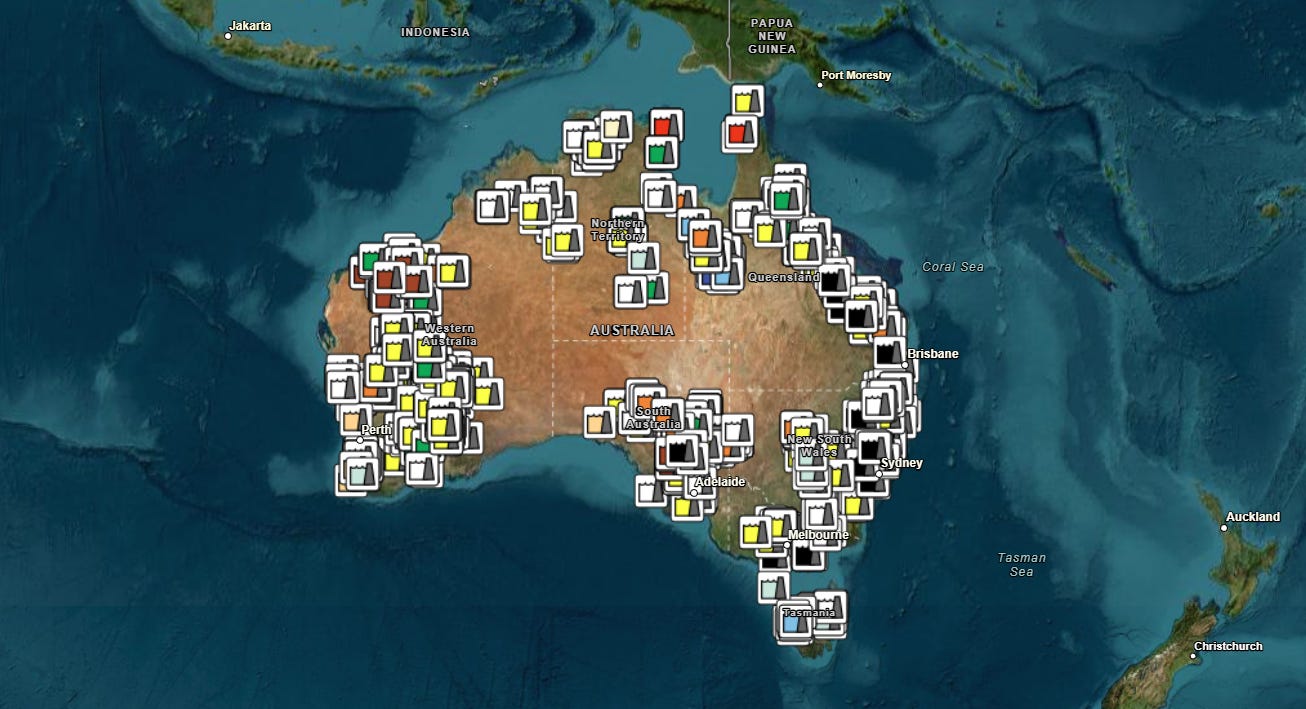
To make these other options real, high-quality data is crucial. Gavin Mudd, MPI’s immediate past-chair, now Director of the Critical Mineral Intelligence Centre at the British Geological Survey served as the lead scientist for the Atlas of Australian Re-Mining Potential, a world-first mapping project by Geoscience Australia, RMIT, and the University of Queensland.
The Atlas identifies 1,050 sites across the continent—waste rock piles and tailings dams—that could be re-processed for critical minerals like cobalt and lithium. This evidence-base allows us to operationalise Principle 7 (Critical Minerals Strategies) and Principle 4 (Mining Legacies):
Minimising Impact: By extracting multiple minerals from a single existing waste site, we reduce the total number of new mines needed.
Healing the Land: Re-mining provides the economic incentive for remediating historical ecological damage through resource recovery, effectively turning a historical liability into a catalyst for restoration.
The Thermodynamic Case for Re-Mining: Recovering the ‘Natural Bonus’
The argument for the Re-Mining Atlas rests on a fundamental thermodynamic reality: exergy – often referred to as available energy. Unlike mass or simple energy consumption, exergy captures both the quantity and the physical quality (concentration and chemical composition) of a mineral resource. This is why Mudd, Valero and Valero argue that exergy is “an accurate and viable approach to quantifying sustainability in mining at a regional or global scale” (Valero et. al 2009).2
Re-Mining: Reclaiming Embedded Exergy
When we mine primary ore, we consume the ‘Natural Bonus’—the millions of years of geological work nature spent concentrating minerals from the dispersed ‘bare rock’ of the crust.
The Sunk Cost of Crushing: A massive portion of mining energy is spent on comminution (crushing and grinding rock). This is a brutal process governed by Bond’s Law, where energy input increases exponentially as particle size decreases.
Tailings as ‘Pre-processed’ Ore: In waste piles and tailings, this mechanical work has already been performed. By treating tailings as our starting point, we ‘reclaim’ the exergy spent by previous generations, effectively subsidising our current energy budget with the labour and energy of the past.
The Material Intensity of Decline
While mitigating climate change is associated with renewable energy use, the broader picture tells us that the sustainability problem is far more complex than it seems. Indeed, the energy issue is the easier part of the problem, where that of materials is more challenging. (Valero & Valero, 2019)
Along with our exponentially growing energy and material needs caused by the need for a growing economy (Garrett, 2011, and Murphy, 2022), we are facing geological drag3: as primary ore grades fall, the energy and material intensity of extraction grows exponentially.
When we move from a 1% grade to a 0.5% grade, we don’t just use more energy; we double the tonnage of rock moved and the volume of tailings produced for every kilogram of metal recovered.
This geological drag is further complicated by the material intensity of the transition itself. As Vaclav Smil (2015) notes, fossil fuels have high power density (concentrated stock), whereas renewables are ‘dilute’ flows that require significantly more physical upfront infrastructure to capture. This creates a ‘material balloon’: generating one terawatt-hour from solar or wind can consume significantly more structural metals than a gas plant.
However, as Mudd notes, this material hunger must be weighed against Energy Return on Energy Invested (EROI). While fossil fuels are ‘power dense’, their EROI is in decline as we exhaust the more easily accessible reserves. In contrast, technological leaps mean the net energy returns for renewables are steadily rising and often already exceed the final-stage returns of the fossil fuel system.
The Re-Mining Atlas can help bridge these two realities: it helps us supply the upfront ‘material balloon’ required for high-return renewables by reclaiming high-exergy minerals from existing waste piles, ensuring the transition doesn’t stall at the thermodynamic cliff, the point where the energy curve ‘blows up’, sharply upward, like a cliff face.
Mitigating ‘Energy Cannibalism’
This thermodynamic cliff is incredibly challenging for the green transition. If we hit the thermodynamic cliff while trying to build millions of wind turbines, batteries and EVs, the energy required to mine the materials (the energy cannibalism) might eventually exceed the energy those devices ever produce, thereby making the entire process unsustainable.
Consequently, this exergetic framework is essential to address the ‘transition ruse’ (upcoming paper by MPI-Murdoch)—the hidden exergy debt required to build new infrastructure. For example, the Valeros (2019) estimate that the exergy replacement cost of minerals for a decarbonised economy by 2050 could exceed the total energy provided by all fossil fuels and renewables combined in that same timeframe.
Since absolute circularity is impossible due to the Second Law of Thermodynamics, we must adopt an “in-spiral economy” (Valero & Valero, 2019). This focuses on separation techniques that recover basic elements from concentrated waste rather than opening new primary mines that create fresh sacrifice zones. In this context, technospheric mining makes complete sustainable sense.
An in-spiral economy that integrates natural resources and waste into its accounting system would stimulate the closing of multiple material cycles. It would encourage political, legal, labor, social, ecological, scientific, technological, business, behavioral, and ethical decisions in favor of greater sustainability for the current and future generations. (Valero & Valero, 2019)
Operationalising Options: Our Recent Advocacy
We are using tools like the Re-Mining Atlas, within the Mining Policy Principles ‘red lines’ framework, to challenge the status quo and show that alternatives to destructive expansion are preferable.
Case Study 1: The Alcoa Expansion (EPA Submission)
In our submission regarding the Northern Jarrah Forest, we argued that Alcoa’s proposal to clear 11,458 hectares ignores the potential of its own existing footprint (see here for our latest on Alcoa’s ‘record-breaking fine’).
The Circular Alternative: While Alcoa markets its aluminium as ‘recyclable’, the current reality is a significant exergy leak for Australia. Australia currently exports roughly 95% of its aluminium scrap, effectively sending away the high-quality, pre-processed metal exergy that should be the foundation of a domestic in-spiral economy.
The Recycling Gap: Absolute circularity is a myth because the Second Law of Thermodynamics dictates that some quality is always lost in each cycle. This is evidenced by the fact that the global aluminium recycling rate is approximately 76%, meaning nearly a quarter of the material exergy is lost to dispersion or landfills. Yet these is precisely the gaps we should seek to fill as tightly as physically possible: we should aim to actually recycle aluminium, rather than simply assert that aluminium is recyclable.
The Renewable End-Use Myth: Although often framed as essential for the green transition, current industrial data shows that renewable energy technologies (solar and wind) account for only about 7% of global aluminium demand (Dixon, 2025, Wood Mackenzie, 2021, Hidayat, 2026). The vast majority of production continues to serve traditional, high-volume sectors like transport and packaging.
The HPA Conflation: Industry proponents often cite the need for High Purity Alumina (HPA) in LEDs and lithium-ion batteries to justify broad bauxite expansion. However, HPA is a niche product representing less than 1% of total global alumina production. It is important to distinguish between materials; while HPA is often on critical minerals lists due to its specialised applications, standard alumina is not classified as a critical mineral. It remains a mature, high-volume industrial commodity that does not warrant the regulatory ‘fast-tracking’ typically reserved for minerals with genuine supply-chain vulnerabilities.
Case Study 2: Northern Australia (Joint Committee Inquiry)
For our submission to the inquiry into ‘emerging industries’ of the North, we urged the Committee to adopt Principle 5 (Regional Planning). This means using the Re-Mining Atlas to identify and prioritise development on disturbed lands before even considering ‘fast-tracking’ projects in culturally or ecologically sensitive ‘no-go zones’.
From Endless Growth to In-Spiral Sufficiency and Justice
The Mining Policy Principles are not a simple ‘no’ to all mining; they are a call for accountability (Principle 6) and a shift toward sufficiency, founded on recognising the need to face up to both bio-physical limits and eco-social (in)justice.4
A just transition means ensuring that when mining does occur, it happens with the genuine, informed consent of communities who have seen all the options on the table. By following the science of the Re-Mining Atlas and its underlying thermodynamic principles, we can transition away from a model of infinite accumulation and toward the ‘in-spiral of life’—a future that values a living forest and a healthy community as much as the minerals beneath them.
Please reach out if your group would like to organise an online presentation of the Mining Policy Principles.
More work from MPI on Mining Legacies:
Pepper, M., Roche, C., Mudd, G. (2014). Mining Legacies – Understanding Life-of-Mine Across Time and Space.
Roche, C., Judd, S., Sangita, B., (2017). Ground Truths: Taking Responsibility for Australia’s Mining Legacies.
Roche, C., Sinclair, L., Spencer, R., Luke, H., Brueckner, C., Knowles, S., Paul, M. (2021). A mining legacies lens: from externalities to wellbeing in extractive industries
In the (2009) Mudd/Valero paper, the authors speak of exergy replacement cost. In the Valeros’ later work (Valero & Valero, 2014, 2015, 2019), the concept is refined into the metric of thermodynamic rarity. It represents the total exergy (useful energy) required to restore a mineral from a state of total dispersion in the Earth’s crust—a hypothetical ‘dead state’ they call Thanatia—back to its current concentration and purity. By calculating this ‘replacement cost’, we can quantify the hidden ‘natural bonus’ nature provided us, which is currently being depleted as ore grades decline globally.
This geological drag due to ore depletion is similar to Garrett’s (2012) inflationary drag caused by natural disasters and infrastructure expansion subject to entropy, causing a double-bind—chosen degrowth or forced degrowth.
For those who checked out footnote #2 on ‘thermodynamic rarity’: an in-spiral economy focuses on reclaiming thermodynamic rarity from concentrated waste streams, slowing the inevitable loss of mineral quality that occurs with every industrial cycle. It seeks to slow the rate of entropy, it is a ‘harm minimisation’ strategy for a finite planet.